



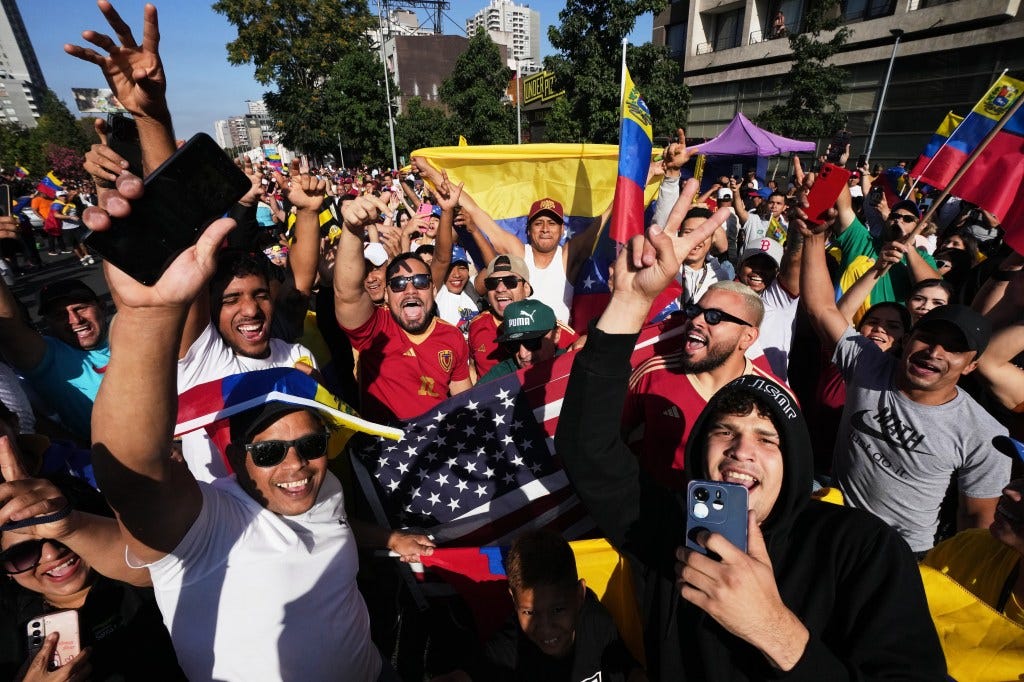
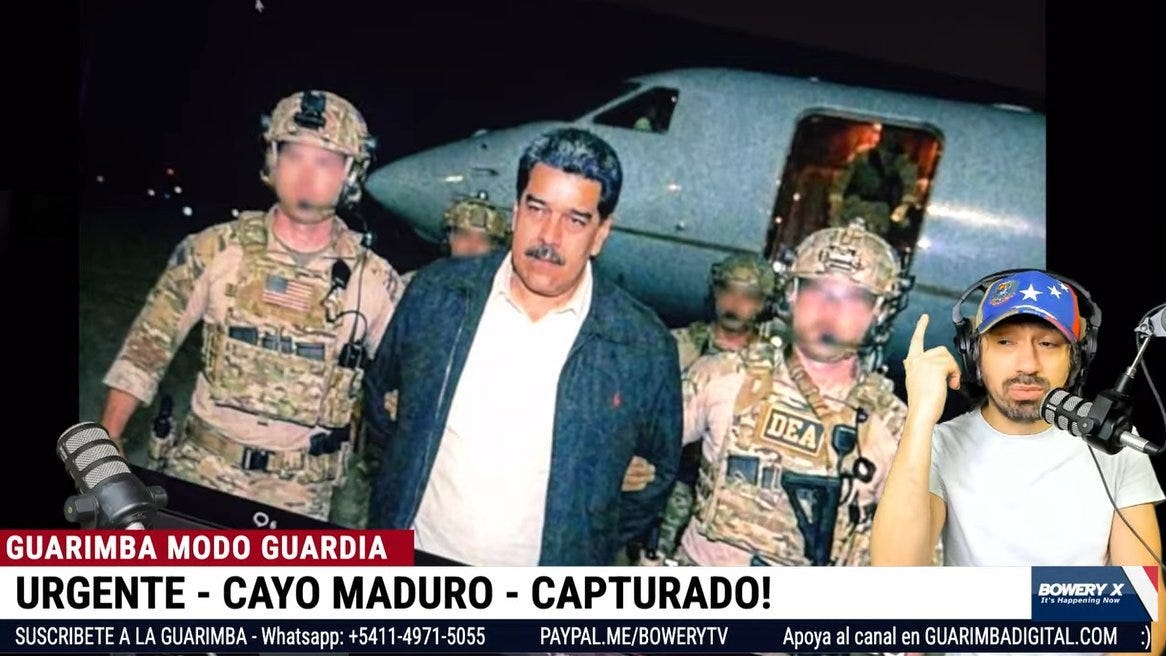
NOTE: Early this morning, U.S. forces captured Venezuelan dictator Nicolás Maduro in Caracas and removed him to the USS Iwo Jima, en route to New York for trial on charges of narco-terrorism and equipping a guerrilla force within the United States.
Maduro’s Socialist regime has bankrupted what ought to be one of the richest countries on Earth. He has invited the Russians, Iranians, and Chinese to use the country he illegitimately controlled as a base in the Western Hemisphere. He has propped up the odious Communist regime in Cuba, and advanced efforts to expand communist control throughout the region. And of course, the drugs he’s smuggled into the U.S. have killed hundreds of thousands of Americans while funding what his otherwise devastated country could not.
Some conservatives are criticizing Trump’s move this morning on grounds that he did not ask Congress for a declaration of war. But that’s wrongheaded. As we’ve previously documented, the President’s actions are fully within the law. You may disagree with the War Powers Act, or the AUMF, or the idea that the Constitution divides power over military action between Congress and the President (as evidenced by George Washington, John Adams, and Thomas Jefferson’s uses of force without such declarations), or UNCLOS, or MDLEA, or the consistent court rulings on point. But if so, your issue is with Congress, not the President, who acted entirely within his established powers.
All of which ignores the elephant in the room: there will be no war, so why would we declare one? These same critics say “they didn’t vote” for more wars, but in fact, they did vote for Donald Trump, who has already been President and has been shockingly clear throughout. Trump didn’t promise withdrawal from the world. Trump promised to use American power to serve American interests, without twenty-year invasions. From ISIS to Iran to Venezuela, that’s exactly what he’s delivered.

But as always, the President is playing a deeper game. Cutting off the flow of drugs secures American streets and forces Venezuela to focus on fixing its real economy. Cutting off the flow of sanctioned oil — capturing shadow fleet tankers — threatens Putin at a crucial moment in negotiations over Ukraine, and reminds China that the U.S. Navy can similarly clamp down on the sea lanes on which it depends for food, energy, and export income. The message is simple as always: play nice and everyone gets rich together; don’t and face Fordow.
The question now: what happens next? Will Maduro’s equally illegitimate vice president take power, or will the duly-elected opposition be installed, and if so, what happens next?
Jason Marczak addressed these issues last month. He paints a picture of tremendous hope and prosperity. With that take shape? The President says “we’re going to run it” until the duly elected opposition can take power, so odds are that it will. Here’s what that looks like. — RDM
by Jason Marczak
December 5, 2025
Venezuelan strongman Nicolás Maduro now faces the greatest challenge to his grip on power since he took office over a dozen years ago. A carrier strike group led by the world’s largest aircraft carrier, the USS Gerald R. Ford, arrived in the Caribbean more than two weeks ago along with long-range bombers, Marines, and other U.S. assets deployed to the region as part of a mission officially aimed at combating narcotics trafficking. Previously dormant military bases in the region have been reactivated in a military buildup focused on narcotics, but with Maduro placed at the center of the effort due to his own ties to trafficking.
And the now-released National Security Strategy (NSS) clearly states the United States’ goals for the Western Hemisphere: “Enlist and Expand.” The latter goal includes ridding the hemisphere of a regime that advances priorities clearly in contrast to NSS objectives by providing safe haven for criminal groups, profiting from trafficking, and welcoming the influence of foreign adversaries.
And as the United States seeks to secure access to critical supply chains, Venezuela presents an untapped opportunity.
Although President Trump has been evasive on what exactly his plans are for Maduro, it’s clear that the president is not authorizing the largest US naval deployment in the Caribbean in forty years — dubbed “Operation Southern Spear” by the Pentagon — only to counter small drug boats. It’s part of his NSS. Trump has recently spoken with Maduro, and reports indicate a possible deal being brokered for the dictator’s departure from the country.
[NOTE: He should have taken the deal. — RDM]
Without Maduro, Venezuela and the hemisphere would rid itself of a cancer. But beyond that, Machado’s plan would transform Venezuela into a bastion of regional security, a supporter of liberty throughout the region, and a trillion-dollar investment opportunity, providing prosperity for its people and Americans along with them.
