

Don’t miss the original “Trump’s Top 25 Achievements” list. And share widely!

This essay is free, but with Premium Membership you get MORE. Join today.
by Christopher Jasper
September 12, 2026
Donald Trump has opened up a new battleground in his trade war with Beijing, and a British start-up building nuclear-powered ships has found itself on the front line.
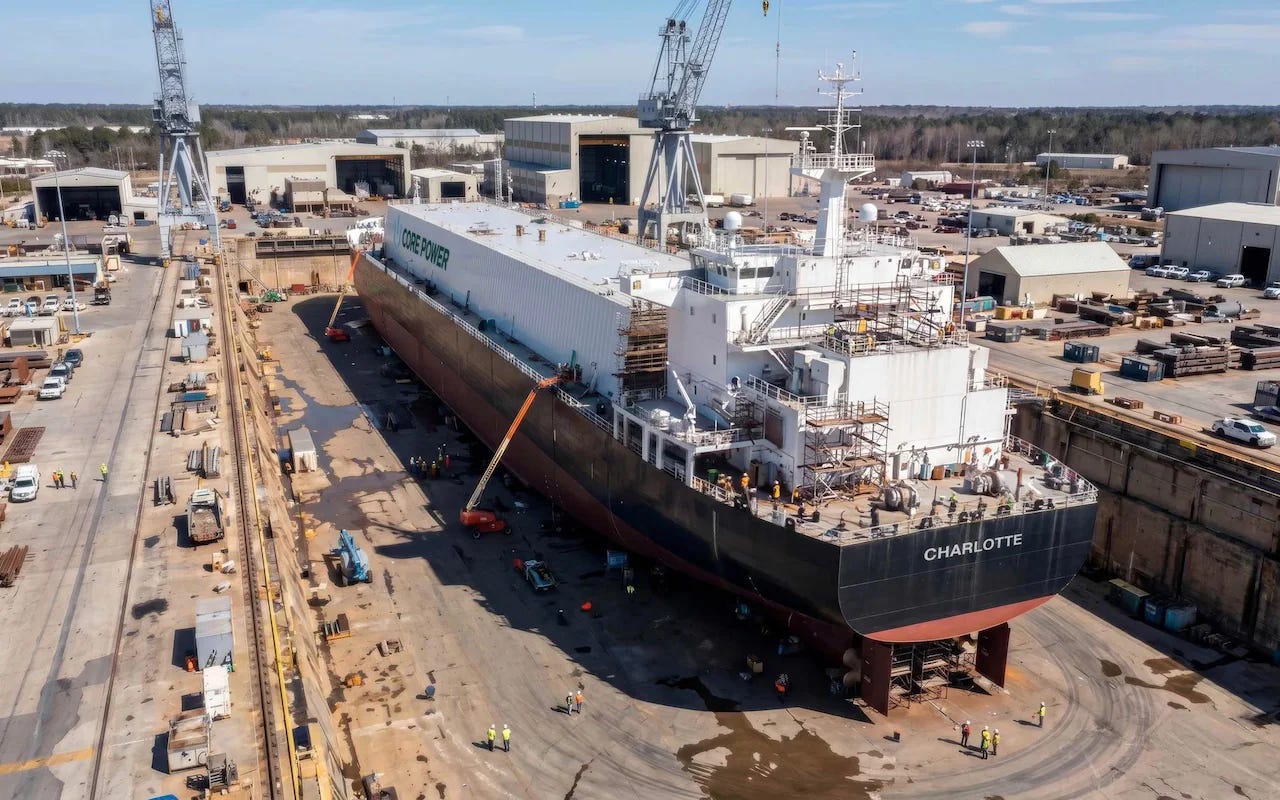
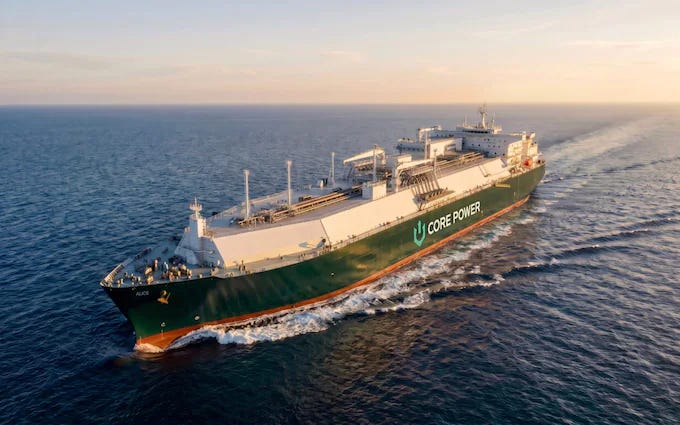
The U.S. effort to challenge China’s dominance in shipping by building a fleet of nuclear-fuelled vessels is being led by UK-based Core Power. The start-up, which has 100 employees and moved to London from Singapore in 2020, says it is unique outside Russia and China in having the expertise to integrate reactors with commercial ships, and the White House seems to agree.
Mikal Bøe, the Norwegian founder and chief of Core Power, flew to Washington last week to sign a seven-year pact with the U.S. Maritime Administration.
“China doesn’t have 75 years of experience in nuclear at sea like the U.S. does. But they are coming and we need to get out there before them,” Bøe said. “The West needs a strong maritime sector or the basis of its naval power disappears and its prosperity, economy and security are undermined.”
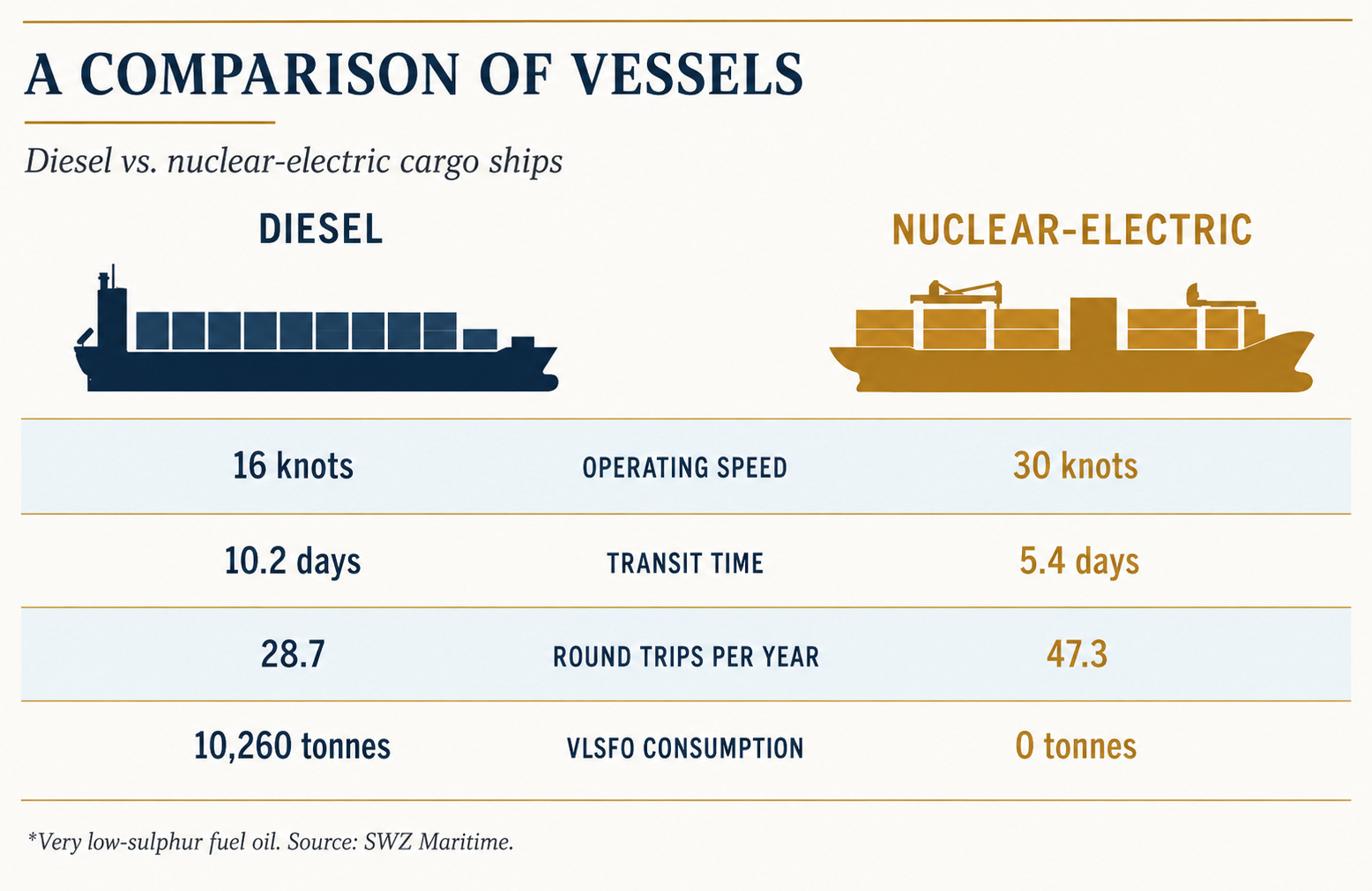
The deal aims to deliver a fleet of zero-emission vessels that travel at 30 knots, or twice the pace of today’s ships, which typically sail slowly to conserve fuel.
They would be assembled in a multibillion-dollar nuclear yard operated by Core Power in the U.S. Work is slated to commence by 2028, with the first deliveries in 2033. Trump hopes the plan can revive American shipbuilding and provide a ready market for a nuclear industry.
While China is developing its own maritime nuclear propulsion, the sector is one of the few in which the U.S. is confident it has a major lead.
Onboard reactors heat water to create steam, which generates electricity to drive the engines, providing a permanent source of power and “free speed”, Bøe said. Nuclear ships could cut transit times for everything from oil and gas to bulk commodities, enhancing energy security amid volatility in the Middle East.
While the nuclear vessels would cost around $700 million, compared with up to $250 million for a large merchant ship, their speed would let them complete far more journeys. Shipping lines could alternatively deploy smaller fleets, with the higher speeds allowing the same volume of goods to be carried with just 60 percent of the industry’s current tonnage.
He said propulsion costs would be competitive with marine fuel, priced at $500 a ton or above. Prices ranged from $660 per ton in Rotterdam to $824 in Los Angeles last week.
An initial batch of up to 50 container ships or liquefied natural gas (LNG) carriers is planned, though the technology could also power ferries, car transporters, oil tankers and cruise ships.
Establishing the business case for nuclear power over traditional engines will open up a market to replace 8,000 ships over the next 25 years, Bøe estimates. He said the first ships could operate on transatlantic routes and that Washington was open to allies becoming involved in the project.
Bøe said the Trump administration had been instrumental in accelerating its plans.
“The pace at which both nuclear reactors and maritime policy and an action plan to build back shipbuilding capacity have been developed is remarkable,” he said.
“You cannot compete with Beijing on its own terms; we cannot outbid them. But we can put these two things together and establish the world’s first program for civil maritime nuclear propulsion which creates a whole new adventure and competes with China.”
Core Power plans to announce a supplier of nuclear reactors for its ships as early as next month, with BWX Technologies viewed as the frontrunner. The company is already partnered with BWX — which helped develop the first nuclear submarine in the 1950s — on plans for floating nuclear power plants to supply coastal industrial complexes.
A decision on the location for its new U.S. nuclear shipyard will follow within the next six months. A facility capable of producing three vessels a year would have construction costs of about $3 billion, increasing to $15 billion to churn out ships for the global market.
The hulls for the ships will be built in Japan or South Korea and floated to the U.S. to be fitted with reactors and engines. The same yard will undertake maintenance and midlife refueling once supplies of uranium are spent.
Backing from Washington should help address regulatory challenges as well as insurance issues, which represent one of the main hurdles to expanding nuclear propulsion beyond military submarines, aircraft carriers and a handful of Russian icebreakers.

Whereas shipping lines today require coverage for damage to their vessels, the loss of cargoes and injuries to employees, the new ships will need a new level of insurance against nuclear incidents.
The Talk of the Industry
Britain’s dominance of the maritime insurance industry could see it play a key role in establishing an insurance regime.
The Technology Prosperity Deal signed by Trump and Sir Keir Starmer last year included a commitment to explore civil nuclear applications at sea and the establishment of a UK-U.S. corridor, which could form the basis of a maritime nuclear insurance zone. The accord was timed to coincide with the launch in Washington of a 25-nation International Atomic Energy Agency initiative to support safe nuclear power in shipping.
Core Power said anti-nuclear sentiment was easing as one-time opponents embrace its potential for replacing fossil fuels.
“Anything ideological gets worn down when it’s proven not to work,” Mr Bøe said. “From a scientific and economic perspective this system is the most logical thing that you could do.”
Core Power has $200 million in financing and will seek to raise a further $600 million next year. While existing investors are mostly shipbuilders and owners, the next round will seek to bring in private equity, venture capital and energy companies.
It has also agreed an alliance with authorities in Corpus Christi, Texas, a major U.S. port, to lay out plans for new infrastructure that will be needed for nuclear-propelled tankers.
Mr Bøe said the door was also “wide open” for Britain to become involved in the sector. “When we started out there was a lot of skepticism,” he said. “But we have built momentum and it has become the talk of the industry. To me it’s almost ludicrous that you wouldn’t pay attention to that. It could be a catalyst for the revitalization of an enormous amount of British industry.
“We chose to build this from London, the beating heart of maritime. Hopefully one day somebody will wake up and say we want to be part of this.”
— This article first appeared in The Telegraph.


My concern with proliferated SMRs is the distribution of nuclear material and the difficulty of securing it. The tech is available, the security is an open question.
I also recommend 'beating' China in about everything! However, at the present time, I would put China on the FRONT BURNER for preventing them sending ANYTHING, especially ARMS to Iran! If those arms include missiles that can sink our ships, that should be viewed as an act of war. There must be several 'simple' Simon ways to block any avenues into Iran from China or anywhere else. As is said in my neck of the woods, "GIT'ER DUN MR. P!"