
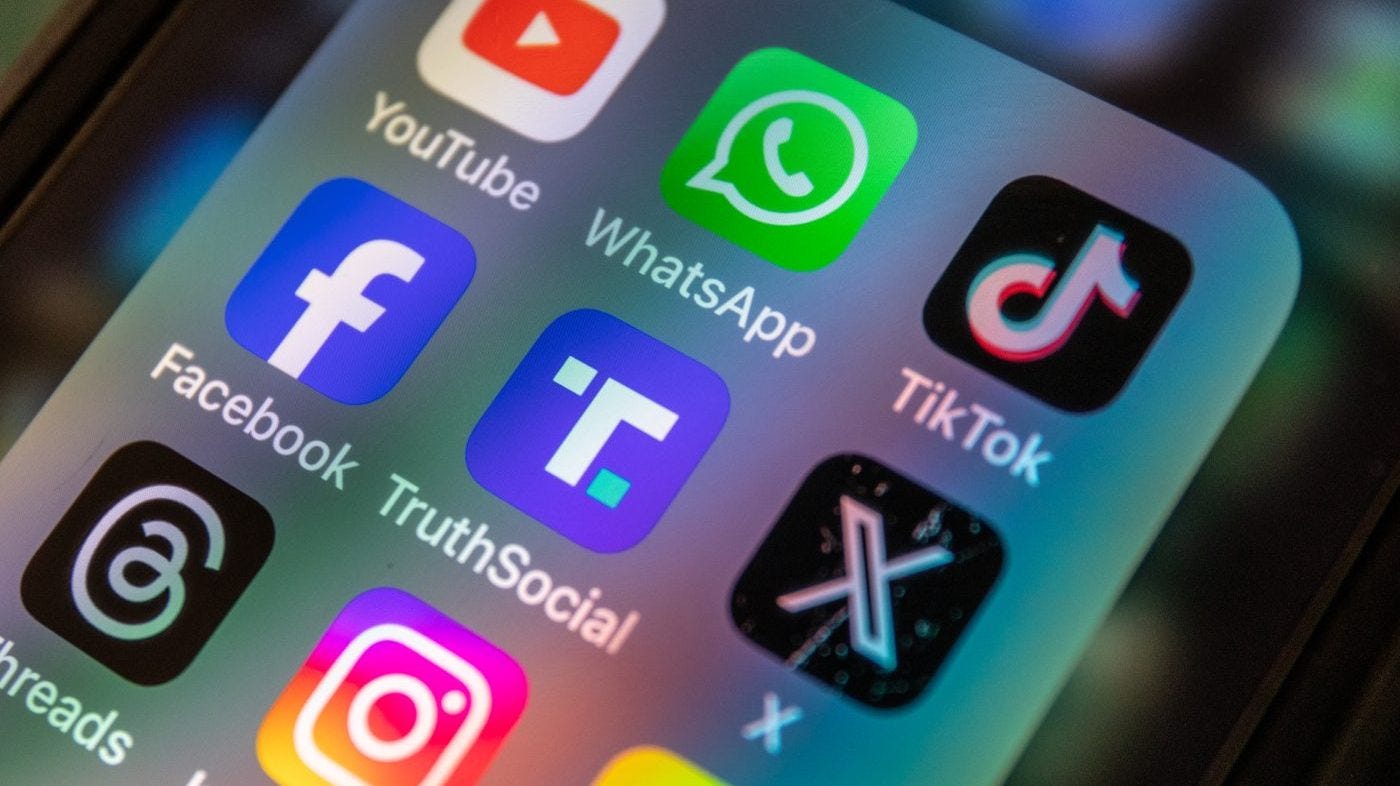
To Preserve the Republic, Technology Platforms Must Uphold Our Rights
Can ubiquitous technology coexist with the right to privacy? Yes. But only if citizens take an active role in shaping the law and protecting themselves.
This essay is free, but with Premium Membership you get MORE. Join today.
by Joe Weil
November 20, 2025
America’s founders knew the surest path to tyranny was unchecked power over the flow of information. So they put in place protections for channels of communication, blocked government control of the press, and prohibited warrantless seizure of property.
But today we carry in our pockets devices that the Constitution’s framers never imagined — smartphones — that have quietly become tools of surveillance and control.
The Founders’ commitment to secure private communication was more than theory. The Post Office Act of 1792 prohibited unauthorized opening of letters, and the Fourth Amendment extended broad protections to personal correspondence. To this day, opening someone else’s mail is a federal felony, and postal employees face criminal penalties if they tamper with or disclose the messages entrusted to them.
Fast forward to 1976 and 1979. Two Supreme Court cases changed the definition of privacy. In United States v. Miller and Smith v. Maryland, the court expanded the legal notion of third-party doctrine, ruling that a citizen’s private information lost Fourth Amendment protection — and could be seized by the government — once it was voluntarily shared with an outside entity. At the time, that meant banks and phone companies, the primary third parties handling personal data.
Did you know your letters are more secure, legally speaking, than your phone calls or internet?
Since then, that doctrine’s reach has expanded dramatically alongside technology, as chronicled by author Byron Tau — now enabling digital advertisers, data harvesters, and tech companies to buy and sell the firehose of personal data that pours from our smartphones into the hands of third parties.
Most of the financial value of our data lies in its use for targeted advertising. But it is also routinely bought by government agencies for social research and investigations — without probable-cause warrants. With just a few taps, officials can see who attends protests, worships at churches or mosques, shops at gun stores, visits gay bars or crypto conventions, or even which websites and apps someone uses. The smartphone advertising industry has turned our phones into the most pervasive surveillance system ever built — one that quietly erodes the very freedoms our devices promised to empower.
The erosion of digital privacy is not the only threat to our freedom and our constitutional rights. Popular smartphone platforms have also become a direct threat to free speech. These devices are no longer just phones; they are the town square and the printing press of modern life, the place where we learn, debate, and share ideas. Yet the corporations that control them have made one thing clear: when speech becomes politically inconvenient, they will silence it.
Between 2020 and 2024, attempts to police debate about election law and COVID-19 produced a censorship regime replete with public cancellations, soft silencing, and redefined terminology reminiscent of 1984. Cooperation between the tech censors and their allies in government blurred the lines between private moderation and state censorship, and evoked the chilling specter of a one-party state.
In 2021, one moment eliminated all ambiguity. Under pressure from activists, all of the largest social media apps had canceled numerous conservative voices. One app stood apart: Parler.
Almost overnight, it became the most popular app in the world. But in that political climate, dissent was not tolerated. On a single day, Apple and Google pulled Parler from their app stores, and Amazon shut down its web services — instantly silencing debate. The very platforms built to connect us became instruments of control.
Some see Big Tech’s invasion of privacy and erosion of free speech as a non-constitutional issue, concluding that the Constitution binds government, not business. That stance rejects government control but overlooks the comparable power of corporations over the same freedoms, not to mention the “loophole” this creates for government to outsource its First, Fourth, and Fifth Amendment violations.
As citizens and consumers, we must recognize our responsibility in shaping the digital future we finance. It’s easy to cast Big Tech as overreaching oligarchs, but the harder truth is that they give us exactly what we pay for — whether with our cash, our clicks, or our data. If we keep rewarding products that surveil and silence us, we should not be surprised when they do just that.
But resistance is growing. A rising movement is challenging Big Tech’s grip and government surveillance — both in the courts and in the marketplace. Civil liberties groups like the American Civil Liberties Union (ACLU) and digital rights advocates like the Electronic Frontier Foundation (EFF) are pressing litigation to restore constitutional protections for privacy and expression.
Meanwhile, innovators are building platforms outside the Apple–Google duopoly to defend user autonomy and digital freedom — and with investors fueling their scale, the movement is building the power to take on Big Tech. It will be American innovation, not regulation alone, that secures our digital future.
But real change will come only if citizens take action and reject the status quo. That means choosing alternatives to Big Tech, demanding stronger privacy protections, and standing up to government overreach and the misuse of our data.
Our founders entrusted us with a republic. Benjamin Franklin warned it could be kept only through vigilance. That charge falls on us now. Preserving it today requires decisive action. We must stop financing platforms that sell our freedoms for profit and start insisting on alternatives that defend them.
We still have the power to choose — but if we fail to use it, the republic, and our liberties, will be lost by our own consent.
— Joe Weil is CEO of Unplugged, a smartphone company dedicated to restoring privacy, protecting free speech, and ensuring that phones safeguard our rights instead of eroding them.


👏👏👏 Thank you, Joe Weil! A phenomenal article that couldn’t be more timely! Social media and smartphones are wondrous and helpful inventions. But they can also help the U.S. government and Big Tech violate our civil liberties, look at our private information and censor speech they don’t like. Remember when social media outlets started censoring COVID dissent at the behest of the Biden Administration? Things like that can happen over and over again if we don’t take action. Our founding fathers gave us broad privacy protections in the Constitution as Mr. Weil recounts here. We need to build on those today. First off, social media platforms need to be declared public utilities and regulated by an independent agency. Secondly, a bipartisan bill must be passed by Congress signed by President Trump to officially extend the first amendment to the World Wide Web. We must also support competing social media platforms like Substack and small businesses to compete with giants like Apple and Google. We need to take a page of Teddy Roosevelt’s playbook and do Trustbusting of the big tech and social media companies. Google in particular, has gotten too big and needs to be broken up.
In addition, we must petition, lobby and protest on Capitol Hill on an extension of privacy rights to the internet and to ban private companies from using or selling our data. Law enforcement also should be forbidden from seeing our data without a warrant and probable cause. We must also put regulations on A.I. Phones should be banned from all schools. There should be a transparent process by which people can be taken down. Also, no one should be able to get to determine what is and is not misinformation or what constitutes a “reliable source.” Social media addictions should be taken seriously and companies should be pressured by the public and congress to reform their algorithms. Net Neutrality should be restored as well. To preserve our republic, depolarize and heal our nation, stabilize western society, and preserve our civil liberties we must tame and civilize the new Wild West!