

by Stephen McBride
June 9, 2026
A single uranium pellet the size of a gummy bear contains as much energy as 140 barrels of oil. It’s the cleanest, safest energy source known to man.
No one who knows what they’re talking about disputes this.
So why don’t we have nuclear-powered everything?
In short: We buried a miracle in paperwork. Since the 1970s building a new reactor has effectively been illegal in America. It required $30 billion and 15+ years in regulatory hell.
I bring good news. In my many travels, I’ve met the world’s best nuclear entrepreneurs (yes, that’s actually a real thing now). I’ve now known many of these guys for a while and have become friends with them. This was the first time they’ve ever said the following to me (and they all agreed):
“Regulation is finally becoming a solved problem.”

One founder said his microreactor (a small nuclear reactor, or “SMR”) could be up and running next year.
So let’s talk about the “problems” remaining with nuclear. What do we do with the waste? And how do we get fuel? We’ll meet the entrepreneurs coming to the rescue on both.
First, let’s quickly look at the big regulatory changes.
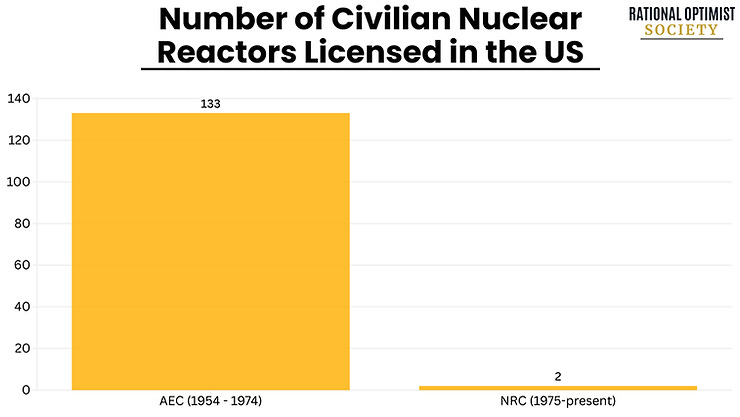
In 1974, a bureaucratic monster called the Nuclear Regulatory Commission (NRC) was born. Guess how many new reactor designs it greenlit between 1974 and 2025?
Zero!
Only two reactors have started commercial operation on the NRC’s watch, compared to 133 before it.
We’re finally righting this wrong. Last year, President Trump signed four executive orders to turbocharge nuclear. These orders trigger five big changes:
Change 1: They set a goal of quadrupling the size of America’s nuclear fleet by 2050.
Change 2. They sped up the development of “advanced nuclear” (read: small modular reactors, or “SMRs”) through pilot programs and streamlined environmental reviews. They ordered the NRC to license new reactors within 18 months.
Change 3. They ordered the Department of Energy (DoE) to approve at least three reactors by mid-2026. Basically, Trump wants three SMRs up and running for America’s 250th birthday.
Change 4. They designated nuclear plants that power AI facilities as “defense-critical infrastructure.” Building nuclear-powered data centers on military bases is a genius loophole. It potentially allows projects to avoid lengthy NRC reviews.
Change 5. This is the most important change in my view: They direct the NRC to reconsider its “As Low as Reasonably Achievable” (ALARA) regulation. You receive more radiation from eating a single banana than you would from living next to a nuclear power plant for a year. Yet under the ALARA rule, even that isn’t safe enough!
This “zero banana rule” has effectively made it illegal to build nuclear plants in America. I think the President should have ordered the NRC to eliminate the rule altogether. But this is progress. An updated rule is expected later this year. And in the meantime, the DoE has eliminated ALARA from its own directives.
Nuclear entrepreneurs have been waiting their whole lives for this moment.
As Matt Loszak, founder of Aalo Atomics said, “We just have to wait for the executive orders to be implemented and we’re off to the races.”
In Detroit, Valar Atomics founder Isaiah Taylor said…
“The problem is no longer in the policy side. It’s now in the engineering side.”
One of the most important engineering challenges is fuel.
Getting fuel was top of mind for many of the entrepreneurs I met. Even if they were ready to power up their microreactors tomorrow, many wouldn’t be able to. They lack the fuel.
How is that possible? Because as with rare earth elements, America regulated its domestic nuclear fuel industry to death, handing control of the supply chain to Russia and China. A similar thing happened with drones.
Getting uranium from the ground to a reactor has four basic steps:
Mining. Companies like Cameco (Canada) dig up uranium in places like Canada, Kazakhstan, Australia, Namibia, Niger, and Russia. Over 85% of the world’s uranium comes from these 6 countries. The raw ore is then processed into a powder called yellowcake.
Conversion. Yellowcake is milled and converted into uranium hexafluoride (UF6) so it can be turned into gas for enrichment. Orano (France) and Rosatom (Russia) control over 50% of the market.
Enrichment. The nuclear “gas” is enriched by spinning it in centrifuges. Three companies, Urenco (European consortium), Orano, and Rosatom dominate the enrichment market.
Fuel fabrication. Companies like Westinghouse (US) and Framatome (France) press and bake the enriched uranium powder into hard ceramic pellets.
America has plenty of uranium in the ground. But thanks to overregulation, it has minimal capacity to process it.
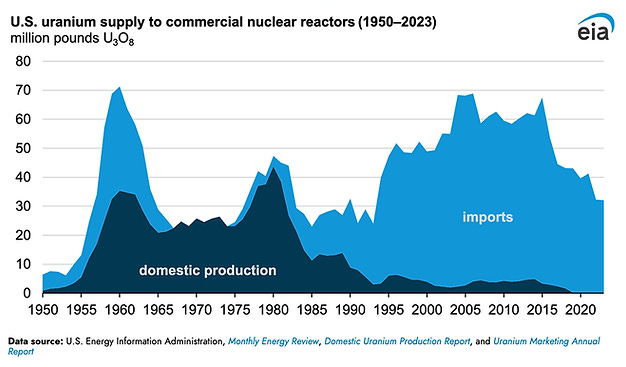
As of 2023, 99% of the fuel used in U.S. reactors was imported – much of it from Russia. That has become a bit…inconvenient.
