



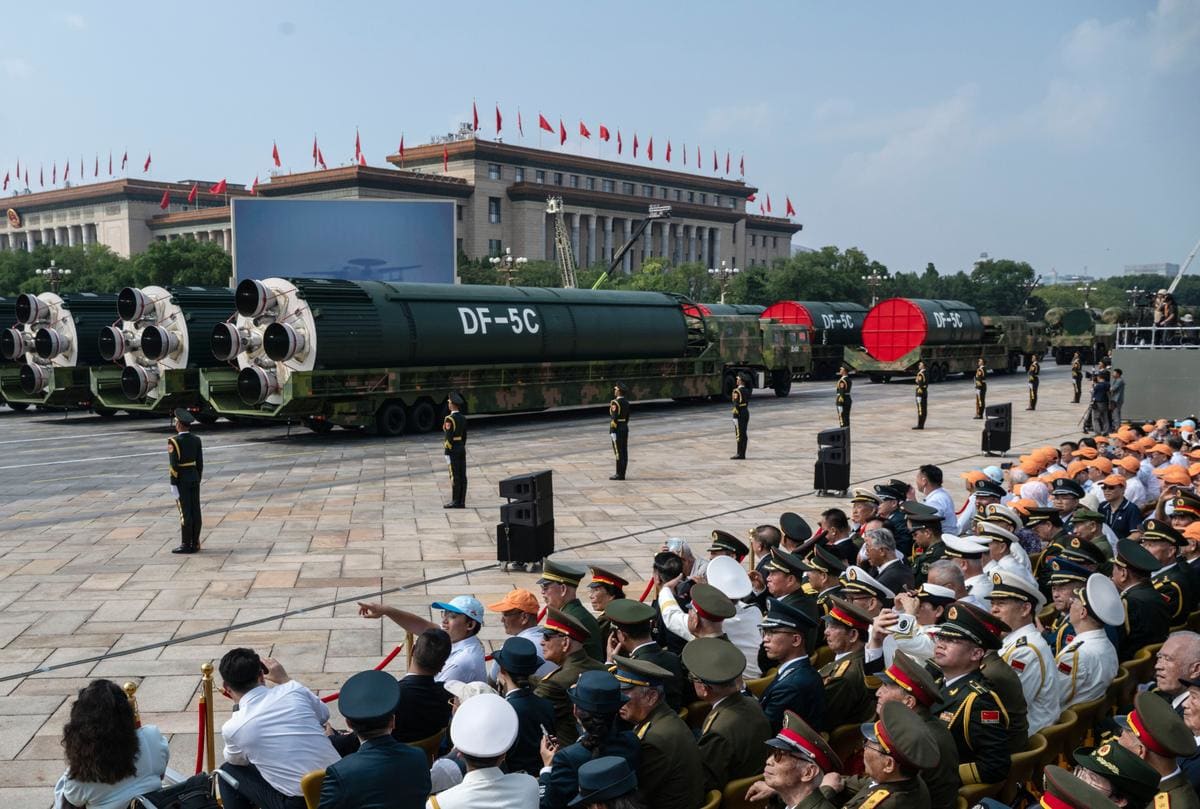
NOTE: I have long asserted the utter uselessness and counterproductivity of arms control…with two principal exceptions. The first is the fruit of Reagan’s “Zero Option”, the 1987 Intermediate Nuclear Forces (INF) Treaty, which for several decades banned an entire class of nuclear weapons. The second is also Reagan’s brainchild: the Strategic Arms Reduction Treaties (or START). “New START” replaced it, but expired earlier this year.
What’s so special? The START treaties did something truly innovative. Remarkable, really. And hardly anyone understands it.
New START capped the number of deployed strategic nuclear warheads at 1,550 and the combined total of deployed and non-deployed launchers (ICBMs, SLBMs, strategic bombers) at 800.
That sounds like a lot of nukes. It’s certainly a lot compared to Britain (225), France (290), India (190), Pakistan (170), or Israel (90). But during the Cold War, each side had 30,000-40,000 strategic warheads. There were implications to that, as there are for the new numbers.
The current limits reduce total strategic weapons beneath the number of must-kill targets. During the Cold War there was always the danger of a first strike, because there was always the possibility that one side might catch the other napping and wipe them out before they could respond. But under the current limits, there is a 100% certainty that your enemy is going to hit you back, hard. The odds of a nuclear war are thus dramatically reduced.
So what’s the catch? China is not and never has been subject to any of these treaties. And now it’s expanding its arsenal from just 200 warheads toward U.S. and Russian levels, if not beyond.
This completely changes the global strategic calculus. It is likely to set off a massive nuclear arms race. And of course, it means Trump’s Golden Dome is every bit as urgent and necessary as he says.
The following article addresses the rapid expansion of the Chinese nuclear force. Americans must understand this threat, especially in light of the increasingly brittle nature of the Chinese state. — RDM

The CCP’s Rapid Nuclear Buildup
by Stu Cvrk
July 16, 2026
China poses a fast-growing nuclear threat to the United States through a relentless, rapid effort to expand and modernize its nuclear arsenal and delivery capabilities.
The People’s Liberation Army (PLA) is executing the fastest and largest peacetime nuclear buildup in history, moving from a “minimum deterrence” force of roughly 200 warheads a decade ago toward a force that multiple U.S. officials now project could approach numerical parity with the United States and Russia within four to five years.
This is a direct military threat: more silos, more delivery platforms, new low-yield and tactical designs, and — per credible but contested reporting — a resumed covert testing program.
Let us examine the topic in some detail.
Historical Trajectory, Production Trends
From the 1970s through roughly 2012, the Chinese Communist Party’s declared “minimum deterrence” doctrine held its stockpile essentially flat at about 200 warheads, carried by a small, mostly liquid-fueled, silo-light force. The Pentagon’s 2020 baseline assessment still placed the arsenal in the low 200s, but that report’s projection of a mere doubling over the following decade has since been blown through entirely.
