

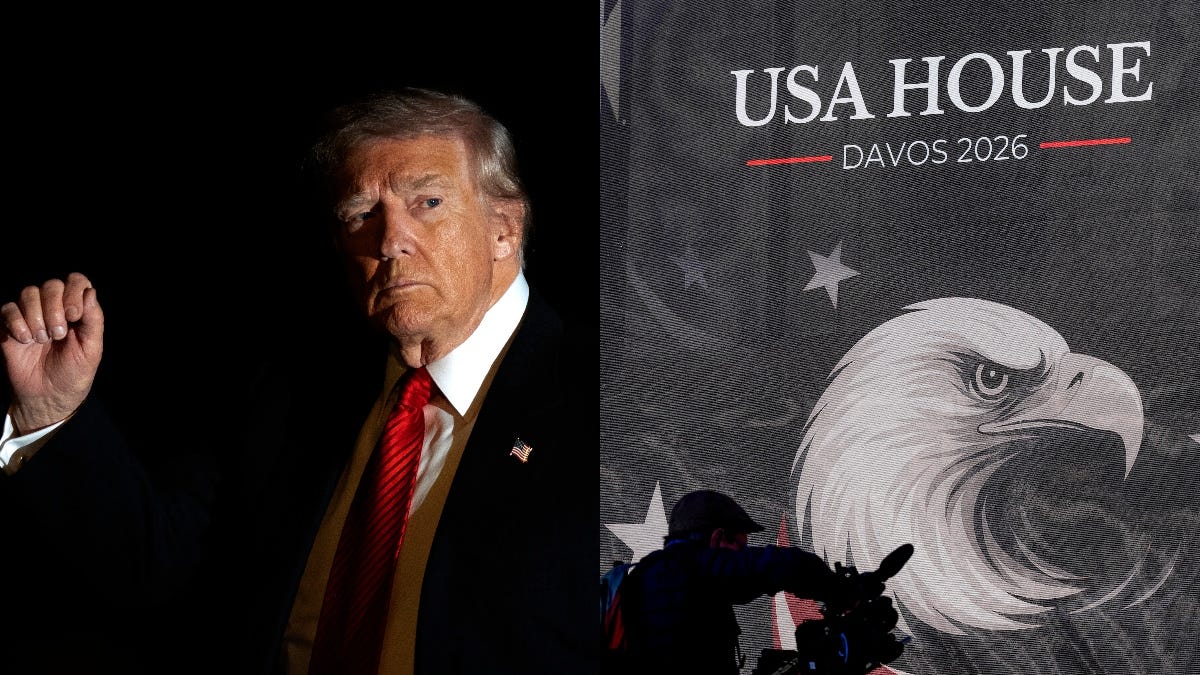
NOTE: As is often the case, I very much agree with Niall Ferguson in his brilliant summation of Davos (as you can readily see from my interview on NTD yesterday morning before he wrote this essay). He fleshes out some of those themes here and draws precisely the right conclusions, particularly regarding the President’s deliberate distraction of Europe from accelerating developments in Ukraine and Iran. Read to the end. — RDM

by Niall Ferguson
January 24, 2026
This year’s World Economic Forum in Davos had an innocuous theme: “A Spirit of Dialogue.” As one European bank chief executive put it, President Donald Trump’s presence contributed something more like a spirit of monologue.
That was one of the better jokes made at the president’s expense this week. And it aligns with a rapidly forming narrative in the European and liberal media that the Europeans “won Davos”: primarily by getting Trump to “de-escalate” his demand that the United States acquire Greenland from Denmark.
On Thursday, Danish prime minister Mette Frederiksen thanked her British counterpart Keir Starmer for his “very strong support to the Kingdom of Denmark.” It had, she said, “been quite a difficult time for us.” But she was grateful “to know that [we] have good friends, strong allies, and that Europeans stand together, don’t get divided, and stick to our, as you said, our common values.” Starmer cooed back in that strangulated voice of his: “We’ve got through the last few days with a mix of British pragmatism, common sense, but also that British sense of sticking to our values and our principles.”
Here at Davos, I’ve heard numerous versions of this sentiment: “We Europeans/Canadians stood up to Trump and forced him to retreat. This is a major victory for the rules-based international order.”
This is a very wrong take. The reality is that Trump won Davos, hands down. And not only did he win it; he owned it. I have never before seen a single individual so completely dominate this vast bazaar of the powerful, the wealthy, the famous, and the self-important.
The “Spirit of Dialogue” I kept thinking about all week was the spirit of the Melian Dialogue. The Melian Dialogue is the most famous passage in Thucydides’s History of the Peloponnesian War, the great conflict between Athens and Sparta that raged between 431 and 404 BC. Like Greenland, Melos is an island (about 68 miles east of today’s Greek mainland). Like Greenland, it had a relatively small population in the fifth century. Unlike Greenland, it was independent — and indeed wished to remain neutral in the war between Athens and Sparta. But in 416 BC, the Athenians invaded Melos and demanded that the Melians surrender and pay tribute to Athens or face annihilation.
In Thucydides’s account, the Melians defied the Athenians. “We are just men fighting against unjust. . .we put our trust in the fortune by which the gods have preserved it until now.” The Athenians gave an immortal reply. “You know as well as we do,” they said, “that right, as the world goes, is only in question between equals in power, while the strong do what they can and the weak suffer what they must.”
This passage has long been seen as the origin of the dichotomy in international relations between idealism and realism.
In case you don’t know, the realists won an emphatic victory. The Athenians besieged the Melians, and on the brink of starvation, the Melians surrendered — whereupon the Athenians executed all the men and enslaved their women and children.
Now, I am not suggesting that the Europeans thought this was what Trump had in mind for the inhabitants of Nuuk, and any Danes sent to defend them from the United States. But I do think they genuinely feared he was contemplating military action to annex Greenland by force.
Davos Man — I should say Davos Person — worries a lot more about such things than he — they — used to. The latest edition of the World Economic Forum’s Global Risks Report, which is based on surveys of business executives and academics, ranks “geoeconomic confrontation” and “state-based armed conflict” as the No. 1 and No. 2 risks most “likely to present a material crisis on a global scale in 2026.” On a two-year time horizon, geoeconomic confrontation remains top of the list. Asked to characterize “the global political environment for cooperation on risks in the next decade,” 68 percent of respondents picked a “multipolar or fragmented order in which middle and great powers contest, set, and enforce regional rules and norms.”
All of this is just a series of Davosy euphemisms for the one big risk that Davos Person fears above all others: Donald Trump.
