

by Clouted
March 4, 2026
The world is running out of places where capital can still buy the future at a discount. Most of the great “emerging” stories are no longer emerging. They are integrated, priced, and already owned.
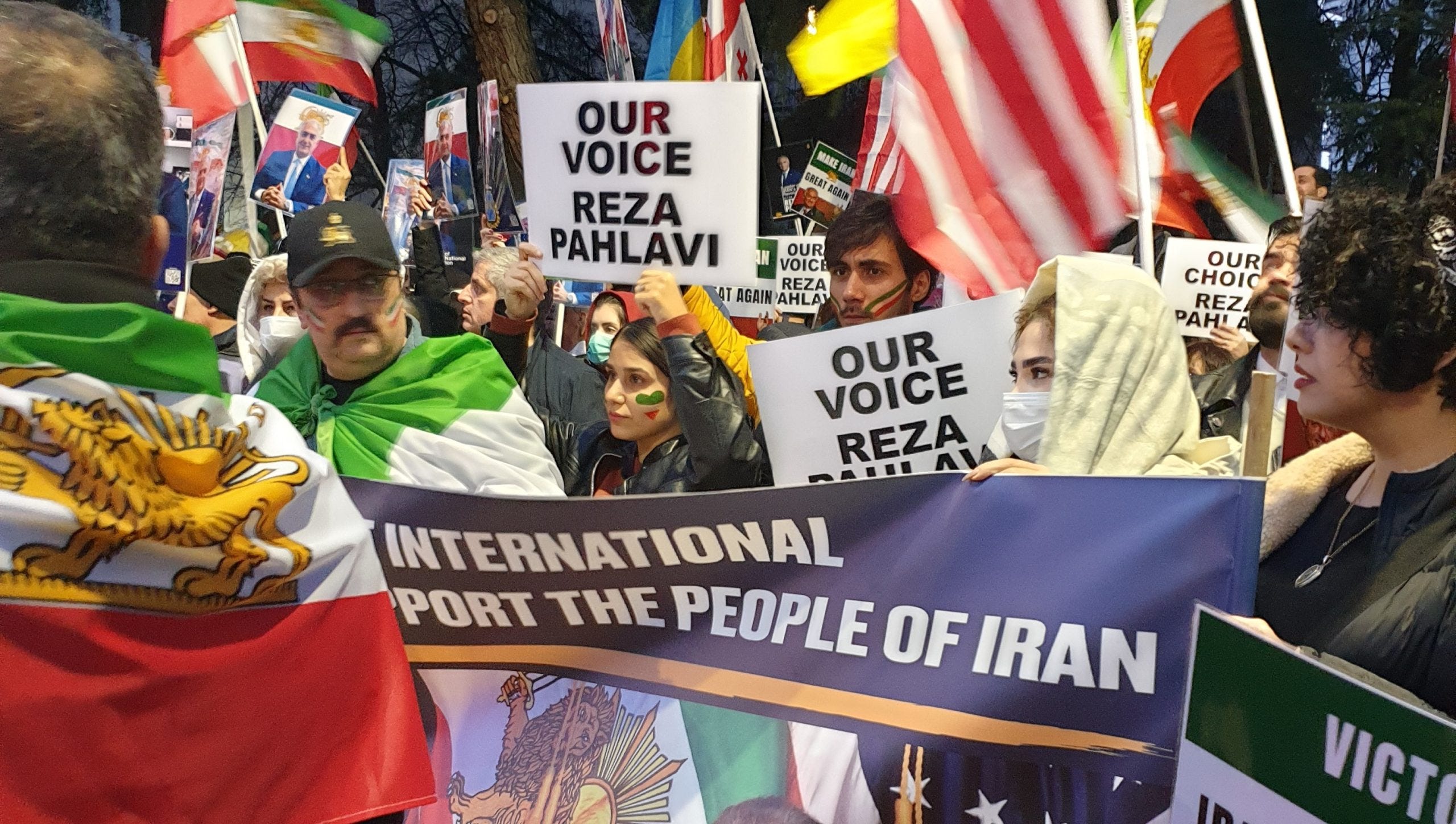
That is why Iran matters more than you think. A country of nearly ninety million people, sitting on some of the largest energy reserves on earth and positioned at the crossroads of Europe and Asia, remains economically frozen not because it lacks scale or capability, but because it remains politically estranged from the global system. If that estrangement ends through a credible transition to a secular, trustworthy, rules-based democracy, the shift will not resemble a routine growth cycle. It will mark one of the most consequential sovereign repricings of the twenty-first century.
The international conversation about Iran rarely addresses this dimension. It revolves around protests, regime fragility, sanctions, nuclear tensions, and regional confrontation. Those issues are real and serious. But they obscure a more disruptive question: what would happen to global capital markets if Iran were no longer treated as an exception, but as a participant?
To answer that question requires looking backward as much as forward. Iran is not a frontier state waiting to be discovered, nor an empty balance sheet awaiting capital. It is a large, industrially capable nation whose fundamentals have existed in tension with its political framework for half a century. If that tension were to resolve, the outcome would not resemble a cyclical rebound or a modest emerging-market recovery. It would look like a parabolic re-rating of a long-dormant power.
And in a world where most large economies are already absorbed into global capital markets, where opportunity is often incremental rather than transformational, Iran stands apart for a different reason. It is one of the last sizable sovereign economies where geopolitics, not fundamentals, has suppressed valuation. When the political ceiling lifts, the scale beneath it will not need to announce itself.
Iran Before the Political Discount
To understand the magnitude of what could occur, it is necessary to recall what Iran once was.
In the early 1970s, Iran was widely regarded as the dominant conventional military power in its region. It was the largest purchaser of U.S. military equipment in the world and the only country besides the United States to operate the F-14 Tomcat. Under Washington’s “Twin Pillars” doctrine, Iran functioned as a cornerstone of Western security architecture in the Persian Gulf. Its military strength reflected not merely procurement, but economic scale, technological integration, and strategic alignment.
But the strategic relationship was only one dimension of Iran’s global position.
Economically, Iran in 1970 generated approximately $10.7 billion in nominal GDP, placing it among the larger economies in the Middle East and within the top tier globally for that period. Tehran was modernizing rapidly. Western firms operated across multiple sectors. Iranian students were present in significant numbers in European and American universities. The Iranian passport, by the standards of the era, was often seen as unusually strong for the region, reflecting a country that was connected, mobile, and outward-facing.
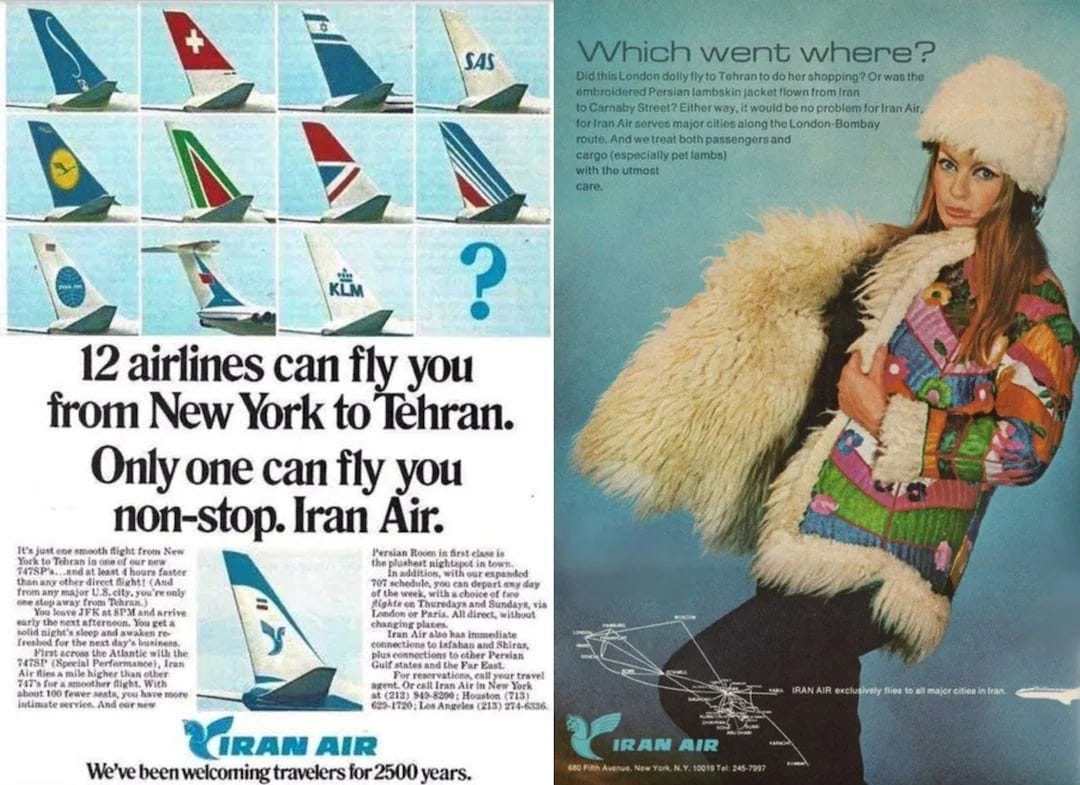
Iran Air embodied that ambition. It was one of only a handful of airlines globally that ordered supersonic airliners. More concretely, its Boeing 747SP inaugurated a non-stop Tehran–New York service and set the world record for direct long-haul flights. At one point, numerous daily and weekly flights connected New York and Tehran, with Iran Air operating the only direct route.
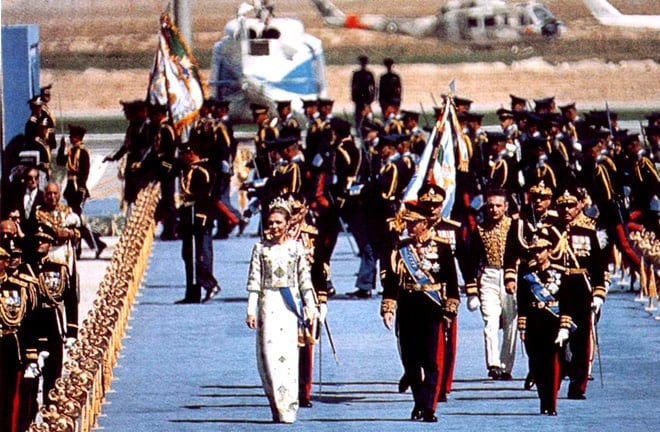
In 1971, the Shah hosted the 2,500-Year Celebration of the Persian Empire at Persepolis, one of the most elaborate diplomatic gatherings of the twentieth century. Heads of state and royal delegations from more than sixty countries attended. The Vice President of the United States, European monarchs, Middle Eastern kings, African royalty, and representatives of major global powers sat together in custom-built tents in the Persian desert for a week of ceremony.
Critics later described the event as extravagant (as if a 2,500th anniversary doesn’t deserve some extravagance). But diplomatically, it signaled something unmistakable: Iran saw itself not as a peripheral state, but as a civilizational heir with a claim to global relevance.

And the ambition was not confined to symbolism. Under the Shah, Iran invested heavily in industrial modernization. Steel complexes were built. Automotive manufacturing expanded. Petrochemical capacity increased. Nuclear energy projects were initiated in cooperation with Western firms. Major infrastructure development transformed transport networks and power generation. The country was not merely exporting oil, it was industrializing at scale.
At that same historical moment, much of the Gulf remained embryonic. Dubai was a modest trading port. Doha had not yet emerged as a diplomatic capital. Riyadh’s skyline bore little resemblance to its current scale. These Gulf states were still, for the most part, barren deserts.
Iran did not decline because it lacked the ingredients of power. It stepped out of the system that was multiplying them. As the global economy became more integrated, more financialized, and more interconnected, Iran, following the Islamic Revolution, moved in the opposite direction.
The Scale Beneath the Ceiling
Strip away ideology, sanctions, and rhetoric, and what remains is a country with one of the most formidable endowments on Earth.
