



NOTE: This morning we wrote about how Trump’s Venezuela strategy pressures Russia, Iran, and China. This afternoon, we take a long look at the “Donroe Doctrine”: Trump’s strategy to kick America’s enemies out of the Western Hemisphere from Argentina to Cuba to Greenland.
To me, the marvel remains the so-called experts who cannot, or perhaps will not, see what’s plainly in front of their face. But as one of our Members, you are not among them. — RDM
by John Haughey
January 9, 2026
With former Venezuelan leader Nicolás Maduro awaiting trial in federal custody in New York City on narco-terrorism charges and U.S. President Donald Trump vowing that the United States will run the country until there is a “proper transition,” the world is witnessing the sharpest manifestation yet of a generational U.S. foreign policy shift which has been taking shape since Trump returned to the White House last year.
Under the “Trump Corollary” to President James Monroe’s 1823 policy that declared the Western Hemisphere a distinct sphere of U.S. influence, removing Maduro from office and seizing control of Venezuela’s oil resources are among the latest and greatest geopolitical maneuvers as part of a renewed focus on affairs closer to America’s shores, most notably and immediately in the Caribbean Basin.
“After years of neglect, the United States will reassert and enforce the Monroe Doctrine to restore American preeminence in the Western Hemisphere, and to protect our homeland and our access to key geographies throughout the region,” the White House stated in November as it unveiled its new National Security Strategy.
The Trump administration’s pivot to Latin America “is a common-sense and potent restoration of American power and priorities, consistent with American security interests,” the document states.
Operation Southern Spear has been in the spotlight off Venezuela since September, with the USS Gerald Ford, the world’s largest aircraft carrier, and the USS Iwo Jima, an amphibious assault ship, as its centerpiece. The massive ships are the most visible components of a campaign that destroyed drug-smuggling speedboats, imposed a selective blockade on sanctioned oil tankers, and led to the Jan. 3 U.S. military operation that captured Maduro.

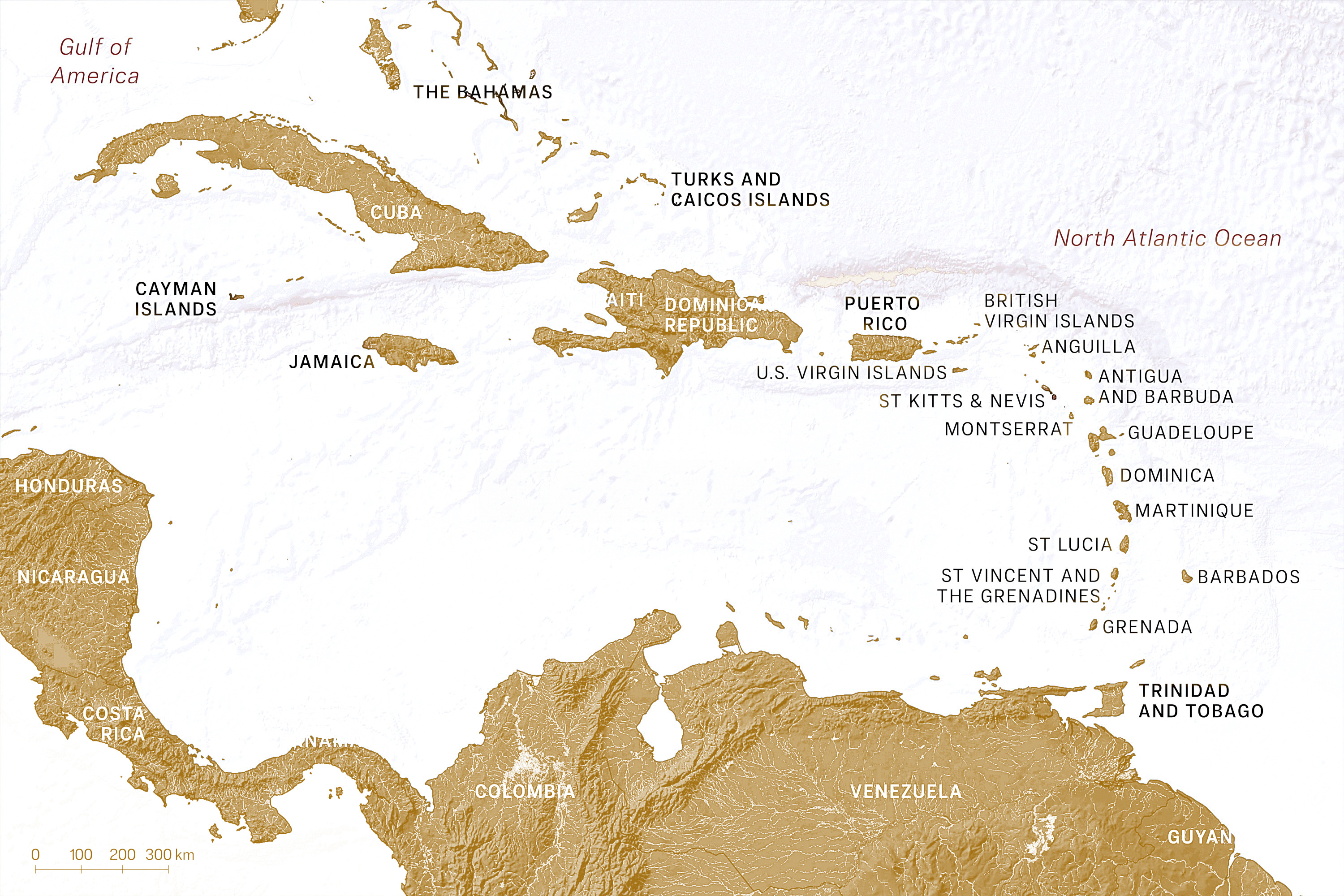
Other key, yet more subtle, regional developments are unfolding in the Caribbean as the Trump administration implements its new strategy. Pressure on Venezuela is having an immediate impact on neighboring Guyana and Cuba, but its longer-term aim is to thwart “non-hemispheric” actors from accessing resources beyond just the Caribbean, from as far north as Greenland to as far south as Tierra del Fuego.
Driving the Chinese Communist Party (CCP) from the Western Hemisphere, or at least diminishing its influence, is the primary aim of this new National Security Strategy.
As Adm. Alvin Holsey, former U.S. Southern Command commander, told the Senate Armed Forces Committee in a Feb. 13, 2025, hearing, Latin America contains one-third of the globe’s renewable freshwater, 30 percent of its forests, 31 percent of its fisheries, 20 percent of its crude oil, and 25 percent of its strategic metals. It grows half the world’s soybeans, grows 30 percent of its sugar, and boasts 60 percent of known lithium deposits.
China has become South America’s largest source of infrastructure investment and second-largest trading partner, increasing trade to $450 billion in 2022 from $18 billion in 2002 and inducing 22 of the 31 nations within Southern Command’s area of responsibility to join the CCP’s Belt and Road Initiative.
From the President’s point of view, that is simply not tolerable. It’s not the only thing.
