


This analysis is free, but with Premium Membership you get MORE. Join today.
by Rod D. Martin
October 12, 2025
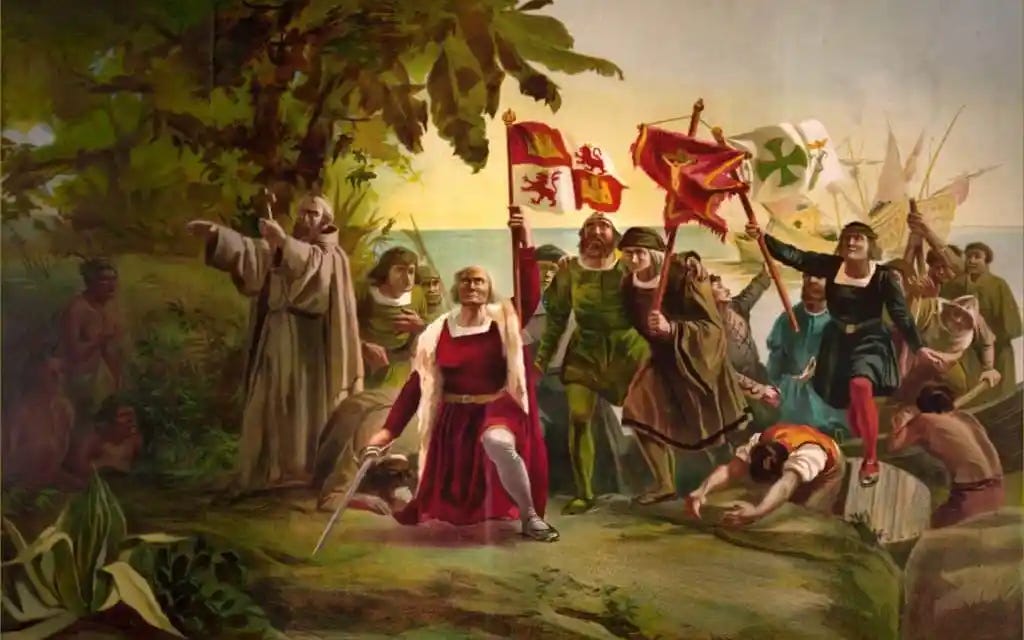
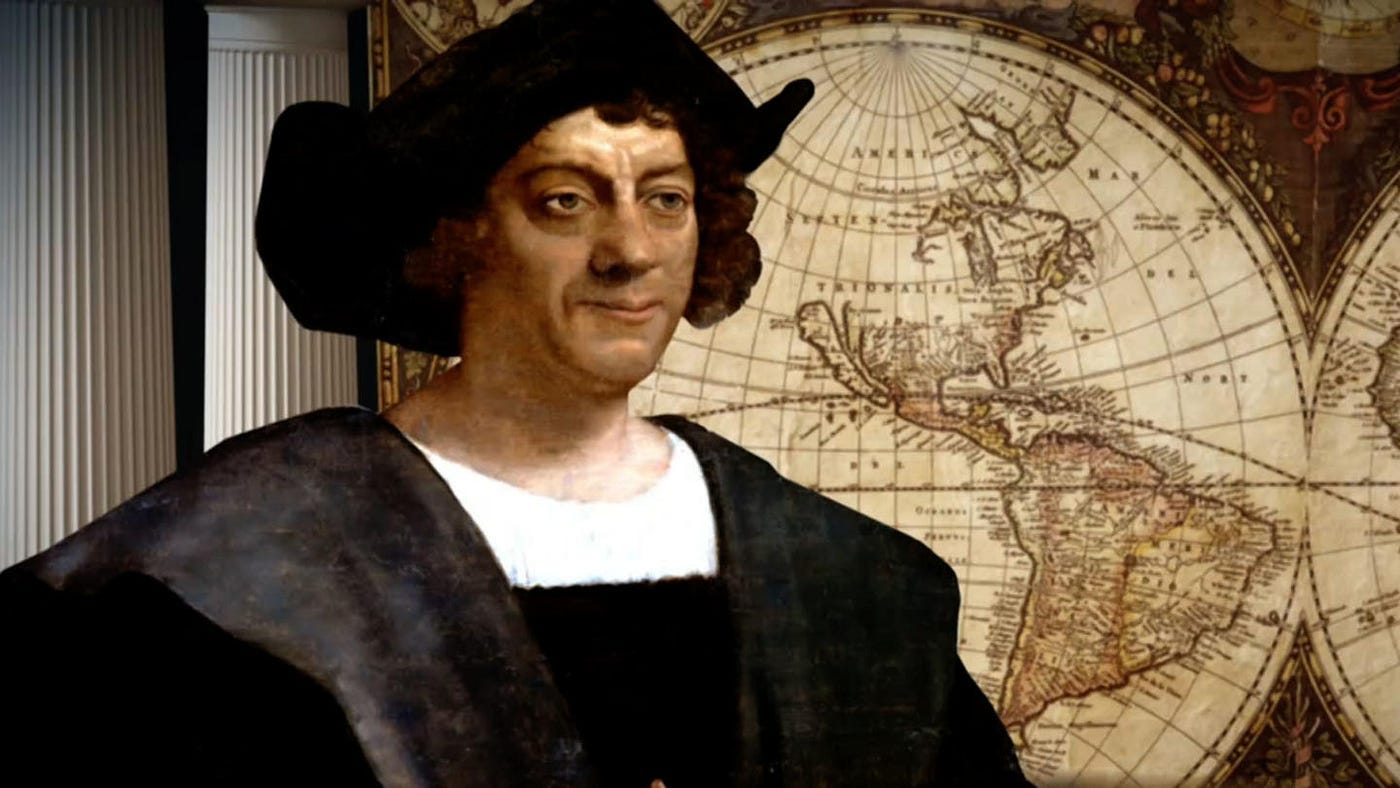
Today we celebrate Columbus Day. This day is a commemoration of discovery, of the audacity to push past the map’s edge for the sake of truth, and the chain of events that led to the creation of America, the apotheosis of Western Civilization.
Which is precisely why the Left hates him, demonizing Columbus as a means of delegitimizing us.
But the truth is the polar opposite of the Marxist myth. Christopher Columbus stands among the most consequential men who ever lived: an adventurer, entrepreneur, navigator, and visionary whose courage cracked the medieval world wide open and let the light in. He bet everything — reputation, livelihood, even his own life — on a daring idea that changed the entire trajectory of human history.
Was he perfect? Of course not. Was he a model for our next era of human expansion and flourishing? Absolutely.
The Man and His Mission
Born in the late Middle Ages, Columbus nevertheless thought like a modern. He was Genoese by birth, Spanish by commission, and American by destiny. He petitioned, planned, calculated, and convinced. He raised capital in a world without established capital markets. He negotiated an extraordinarily entrepreneurial contract with the Spanish Crown (which it later broke). He understood risk — and he shouldered it.
He did all of this self-consciously as a Christian. Columbus believed God had set before him an open door: that the seas could be crossed, the world mapped, trade expanded, poverty reduced, and the Gospel carried farther than Europe had yet imagined. Read his own words and logs and you meet a man of prayer and providence, not some Hollywood villain. Postmodernist critics strain to hear him, if they bother to try at all, because they no longer share his premises. Their presentism and subjectivism obscures the truth, which for Columbus was anything but presentist or subjective.
Columbus embodied the best of what we think of as the American spirit long before there was an America. His venture was, in the purest sense, a startup with a ship. He was a man who refused to accept conventional wisdom, who built the plan, hired the team, secured the funding, and launched the product. And the little fact that his original model was incorrect — the idea that the Americas were not in fact East Asia — stripped not one iota of value from his otherwise directionally correct venture.
If there were a patron saint of entrepreneurs, Columbus would be the man.
In one especially modern twist, when the Crown later reneged on the contract it had signed, Columbus and his heirs sued. To this day, much of what we know of the “Admiral of the Ocean Sea” comes from the legal record of those lawsuits. That’s not the biography of a medieval barbarian. That’s a man who understood covenants, contracts. He was an adventurer, yes. But first and foremost, he was a venturer.
What Columbus Ended — and What He Began
Columbus was an explorer. He died a generation before Cortez or Pizzaro. He believed he’d reached East Asia. Virtually all the sins, both real and imagined, that are heaped upon him were unknown to him. One might as well blame George Washington for the Great Depression. The criticisms are largely nonsensical.
Columbus is accused of “ending paradise”. But what did he actually end? He ended the isolation that kept both hemispheres’ peoples impoverished and parochial. He ended a technological and commercial segregation that shackled human advancement. He ended the Middle Ages in Europe, expanded the physical and intellectual horizons of millions, and helped birth the modern world.
And even more important than what he ended is what he started.
Because Columbus sailed, a civilizational exchange unlike any before it was set in motion. The Columbian Exchange eventually sent crops, animals, ideas, technologies, and people back and forth across the Atlantic. It made possible the rise of nations in the New World that would, in time, proclaim and protect the rights of man. It created the conditions for the American experiment, which — despite our sins and struggles — has been, aside from salvation, the greatest blessing to the greatest number in the history of the world.
Yet the same modern world Columbus’s courage made possible now vilifies him. The modern caricature — mass murderer, genocidal maniac, proto-colonizer — is moral theater untethered from history. It rests on two pillars: first, the tragic collapse of Native American populations after first contact; second, a willful blindness to the world Columbus actually encountered.
On the first point, the facts are devastating but plain: the overwhelming majority of the deaths in the Americas were caused by disease, not by conquest: a medieval War of the Worlds that left most of the New World empty. The scale of this is almost incomprehensible.

This is horrifying. But it isn’t genocide. Europeans did not know what microbes were: they certainly had no idea that New World populations might not share Europeans’ immunity to them. Germ theory would not emerge for centuries. And indeed, the death toll was not one-way: a larger number, though a smaller proportion, of people died in Europe of New World diseases than died in the Americas.
As to the second point, we should be honest about pre-Columbian America. Critics attack Columbus for “ending” indigenous cultures. They never ask whether you would have wanted to live in any of them.
The hemisphere was not some untouched Eden populated by gentle environmentalists living in harmony with nature or each other. They practiced slavery. They went to war, unendingly and relentlessly, with each other. The Aztecs conducted human sacrifice on an industrial scale. In parts of the Caribbean, the strong preyed on the weak with a cruelty that shocks modern sensibilities. The Plains cultures we romanticize as “ancient” horse peoples existed only after horses arrived from Europe, and they became every bit as barbaric as the Mongols without their corresponding achievements. History is not a morality play with cardboard heroes and villains. It is fallen men in fallen cultures, everywhere, across time.
The narrative is nonsense. But as with so many of the left’s modern narratives, it has a singular, presentist purpose: demonizing Columbus is a useful lie meant to delegitimize America. Most of his critics know little about him. They just know they hate us.
What stands out about the West — what Columbus began to unleash on a global scale — is not that Europeans have been sinless, but that Western civilization has produced the most sustained self-critique, the deepest legal protections for individuals of all stations, the broadest diffusion of literacy, science, technology, and markets in human history, thus lifting billions out of misery. The Christian West abolished slavery, ended human sacrifice (unless you count abortion), and widely spread the idea that “all men are created equal.”

Did they get there all at once? Of course not. But without them, no one would have gotten there at all.
The fruits of that civilizational arc — rule of law, individual rights, modern medicine, sanitation, regular harvests, the end of famine, property rights, human dignity — are enjoyed today by the children of the “indigenous” and “settlers” alike. If you were a little Sioux girl with a passion for mathematics, or a dream of becoming an astronaut, or a CEO, when would you rather live, then or now? Be honest.
That is not a footnote to Columbus’s voyages. It is their long-term consequence.
Why We Celebrate — And Why We Ought To
We live in a time that unendingly calls good evil and evil good. The same people who enjoy every material and moral benefit of the civilization Columbus helped set in motion spend their days trying to tear it down. They topple statues, rename holidays, and demand ritual confessions from free citizens whose only “crime” is gratitude.
Resist them. Gratitude is the opposite of the envy that would burn down the world if it could. Gratitude remembers what was risked, and what was gained. Gratitude judges men by the standards of their times, learning from them without surrendering our own. Gratitude says: we are not ashamed of the West, because the West — self-correcting, self-critiquing, open to repentance — is by definition a process of ongoing improvement. And because of that, it has been the most humane engine of human flourishing the world has seen.
And of course, gratitude tips its hat to the man who first sailed west and did not fall off the edge. How many of us would have shown such courage and intrepidity?
Columbus Day is not a token of tribe but a testament of civilization. It teaches that courage builds, that faith propels, that law orders, that vision transforms. The good we inherit was not conjured from thin air — it was bought with risk and sweat, vision and prayer. Someone dared the edge of the map. Someone left a familiar shore and bet his life on a horizon he could not see. Someone believed the world was knowable, and proved it.
The Next Horizon
If you need one more reason to celebrate Columbus Day, look up. The same spirit that carried three small ships across an unknown ocean is what lifts rockets from Starbase and Cape Canaveral and will, God willing, carry men and women to Mars and beyond.
This is not kitsch. It’s continuity. The line from 1492 to the launchpad is the line of human daring squared with providence, of reason married to faith, of risk yoked to purpose. It is a line that says: God made real worlds and filled them with real wonders, and He made us to subdue them — not as vandals, but as stewards — to make all creation in the image of the Garden, and fill it.
We stand on the shore of a new ocean, one as vast as the heavens, containing wonders we cannot yet comprehend. But we will.
Columbus was not perfect. None of us is. But he is a worthy model of audacity in the service of something higher.
So celebrate. Teach your children who Columbus was and why he matters. Read a page of his log. But most of all, be grateful for the better world his voyages made possible — and resolve to be worthy of it. The wonder of Western Civilization is not an accident: it’s an inheritance. It can be squandered, as many are attempting. It can also be renewed. And if civilization is not merely to endure but advance in our day, we must appreciate his audacity and achievement to inspire a new generation of similarly intrepid explorers.
Happy Columbus Day.


Here are some excellent books on Christopher Columbus:
• Admiral of the Ocean Sea: A Life of Christopher Columbus by Samuel Eliot Morison
• Christopher Columbus: His Story and His Journals by Edward Everett Hale
• The Enemies of Christopher Columbus by Thomas A. Bowden
• Christopher Columbus The Hero: Defending Columbus from Modern Day Revisionism by Rafael Ortiz
• Christopher Columbus The Hero.2.: Debunking The Accusations That Led To His Arrest by Rafael Ortiz
• Columbus and the Quest for Jerusalem: How Religion Drove the Voyages that Led to America by Carol Delaney
• Columbus and the Crisis of the West by Robert Royal
👏👏👏🇺🇸🇺🇸🇺🇸 Thank you, Dr. Martin for an outstanding piece on Admiral Christopher Columbus the Grandfather of America! Without him, none of us would be here today! Christopher Columbus is a much maligned but little understood historical figure. Columbus was not a prefect person by means. But he was a hero who’s courage, daring, willingness to take risks, and ingenuity led to the discovery of America and the connecting of America with the rest of the world. He didn’t hate the Indigenous people. In fact, he ordered his men to treat the Taino people with kindness and not to steal their property. It was the Caribs the other tribe on the islands Columbus had a problem with. That’s because they were cannibals who threatened and attacked the Tainos. Columbus and his men allied themselves with the Tainos and helped protect them from the monstrous Caribs who considered babies as Pulitzer Prize winning historian Samuel Eliot Morison put it “a tasty morsel.”
Columbus and his men had always thought as most people in the West believed back then, that the world was full of monsters as described in the Ancient Greek and Roman texts. So Columbus and his men at first weren’t sure what to make of the Indigenous people. Were they monsters? Were they savages? Were they a more primitive type of human? They eventually came to the conclusion they were people just like them. If you read Columbus’ journal, you’ll also see he saw them not as racial inferiors worthy of enslavement but rather potential subjects of the Spanish Crown and Christians. Did Columbus sell Natives into slavery? Yes, but only those from rival tribes and only at certain times. Members of tribes the Spanish were allied with were treated with kindness and paid for their work.
There are many ridiculous myths about him out there. No, he didn’t traffic young girls. No, he didn’t cut off Native people’s hands if they didn’t find enough gold for him. No, Columbus didn’t commit genocide or start the Transatlantic Slave Trade. Yes, he DID discover America! The Vikings don’t count because their settlements didn’t last. The Native Americans yes, were already here but for the most part they were nomadic and didn’t have any permanent settlements. Columbus and the Spanish did, thus the Admiral rightly gets the credit for this accomplishment. As to the Indigenous peoples of the New World, the vast majority of them tragically died from diseases the Europeans brought they had no immunity to and that the latter were totally unaware of. Plus, it’s not like before Columbus’ arrival, the Indigenous peoples of the Americas lived in the Garden of Eden, far from it. They conquered each other’s land, fought bloody wars with each other, enslaved one another, and practiced cannibalism, human sacrifice and head hunting. The Indians weren’t angels and the Europeans weren’t devils. Both could be kind or cruel based on the situation.
We should absolutely celebrate Columbus Day to commemorate the heroism and daring of the intrepid explorer and navigator who discovered the New World and a whole new continent. His spirit of adventure, tenacity, dogged determination, and piety should never be forgotten. I also wanted to mention, Columbus’ voyage was NOT just about finding a route to Asia to trade for spices. He also embarked on the voyage to the Americas to raise for another crusade to take back the holy city of Jerusalem for Christendom. So it wasn’t just a spirit of adventure that made him take that famous voyage, it was also his deep seeded Christian faith. I’m glad President Trump made Columbus Day a national holiday! It’s well deserved! It’s also ridiculous people are tearing down his statues and removing his name from buildings. He didn’t commit any of the horrific crimes he’s been accused of by leftists or activists. It should also be noted that the Ku Klux Klan hated Columbus Day because it represented an America where all people regardless of religion or ethnicity could live together under one flag. The push to demonize and erase Columbus is a push to delegitimize America and western civilization.