

Don’t miss our FREE Deep Dive on Trump’s game-changing submarine strategy.


by Robert Bryce
August 15, 2026
In 2019, former New York City Mayor Michael Bloomberg announced that his charitable organization, Bloomberg Philanthropies, would give $500 million to the Beyond Carbon campaign, an effort designed to “finish the job” of transitioning the U.S. “from coal and other fossil fuels to 100 percent clean power.”
In 2021, Bloomberg’s charity launched a campaign “to close a quarter of the world’s 2,445 remaining coal plants and all 519 proposed coal plants by 2025.” Bloomberg said his group would achieve that goal by expanding its efforts from the U.S. and Europe to “25 developing countries where coal power is projected to rapidly grow.”
In 2023, Bloomberg was at it again. He announced that he was donating an additional $500 million to the Beyond Carbon campaign, which Earthjustice said was “one of the largest philanthropic efforts to fight the climate crisis in the U.S.” In a press release, the group said that by 2030, it aims to “shut down every last U.S. coal plant.”

Hillsdale College’s wonderful “The Story of America” series is now FREE for you to watch! Learn about the most important episodes in America’s Founding.
Click here for the full series!
Yes, well. Bloomberg may be lavishing a cool $1 billion on his activist pals at Earthjustice, Sierra Club, League of Conservation Voters, and other groups, but a bunch of Asian countries didn’t get the memo about quitting coal.
I recently returned from a trip to three of the world’s fastest-growing countries: Vietnam, Singapore, and Malaysia. It was my first trip to Southeast Asia, and it was a remarkable experience. Saigon is a boom town. Construction cranes were visible throughout the city and all along the Saigon River. In Singapore, new buildings were going up all around the Marina district. From the top floor at the Hilton Kuala Lumpur, I counted more than 30 construction cranes.
All three cities were clean and safe, the people were friendly, and the vibe was optimistic. There’s reason for the optimism. The major economies in Asia are booming, foreign capital is flowing in, and incomes are rising.
What’s fueling Asia’s economic boom? Coal-fired power plants.
I may be spoiling my own punchline, but here it is: The U.S. isn’t really using less coal. Instead, it has exported its coal use to Asian countries. These seven charts tell the story.
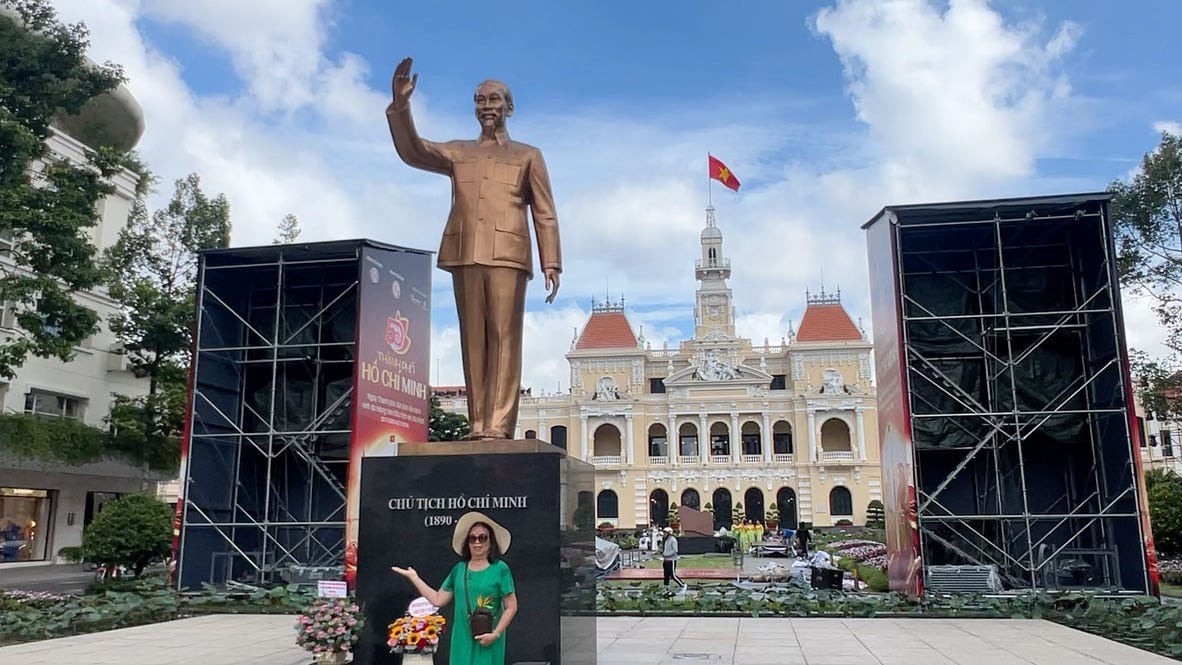
I’ll start with Vietnam, a country that has become a manufacturing powerhouse. In 2025, Vietnam’s economy grew by 8 percent. That means its economy will double in size roughly every nine years.
Three factors are driving Vietnam’s manufacturing boom. First, the country has a large working-age population, which means labor is relatively cheap. Second, it’s a big country with lots of land available for new factories. And finally, and perhaps most important, global companies are reducing their dependence on Chinese suppliers and supply chains.

In Singapore, I interviewed an investment strategist who called this “the China Plus 1” strategy. He told me that due to the rising tensions between the U.S. and China, “companies are realizing that they should diversify. So they are not reducing their manufacturing in China, but they are building new manufacturing centers outside China.”
Vietnam has been one of the biggest beneficiaries of that strategy. More than $100 billion in foreign direct investment has gone into Vietnam since 2020 as multinational corporations like Intel, Samsung, Apple, Foxconn, Nike, Adidas, LG, Unilever, Nestlé, Cargill, and others have flooded into the country.
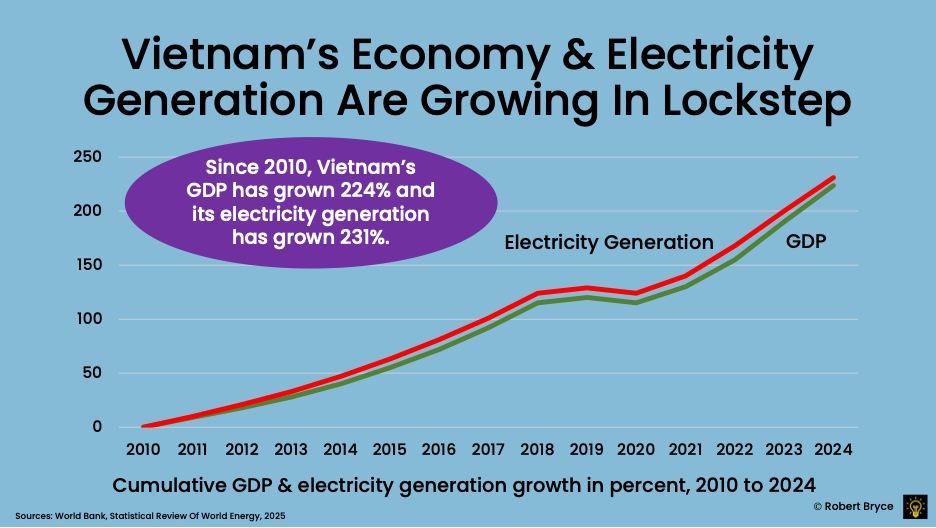
As shown above, Vietnam’s economic growth and its electricity generation are closely correlated. That’s not a surprise. Economic growth drives electricity use, and electricity availability fosters economic activity.
So here’s where coal comes in:
