


by Rod D. Martin
January 17, 2015
Facebook is again filled with defenders of Islamist "feelings" in the aftermath of the Paris attacks. Eventually but invariably they invoke that favorite liberal trump card, the Crusades.
But I have to marvel at the tendency of these people to focus so heavily on a handful of European invasions of a tiny part of the western Levant (primarily modern Israel, which is the size of a postage stamp), all of which happened 800 to 900 years ago anyway, without a thought to:
1. The Muslim conquest and forced conversion of that same area just a few centuries earlier.
2. The Muslim conquest and forced conversion of all of Christian Egypt
3. The Muslim conquest and forced conversion of all of Christian Libya
4. The Muslim conquest and forced conversion of all of Christian Tunisia and Algeria (as they are called today)
5. The Muslim conquest and forced conversion of all of Christian Morocco (as it is called today)
6. The Muslim conquest and forced conversion of all of Christian Spain and Portugal, resulting in a 700 year war of liberation which was only won by the conquered native inhabitants a month before Columbus sailed to the New World.
7. The attempted Muslim conquest of France
8. The Muslim conquest (later reversed) of Sardinia and of Sicily
9. The Muslim conquest and forced conversion of all of Christian Asia Minor (now Turkey)
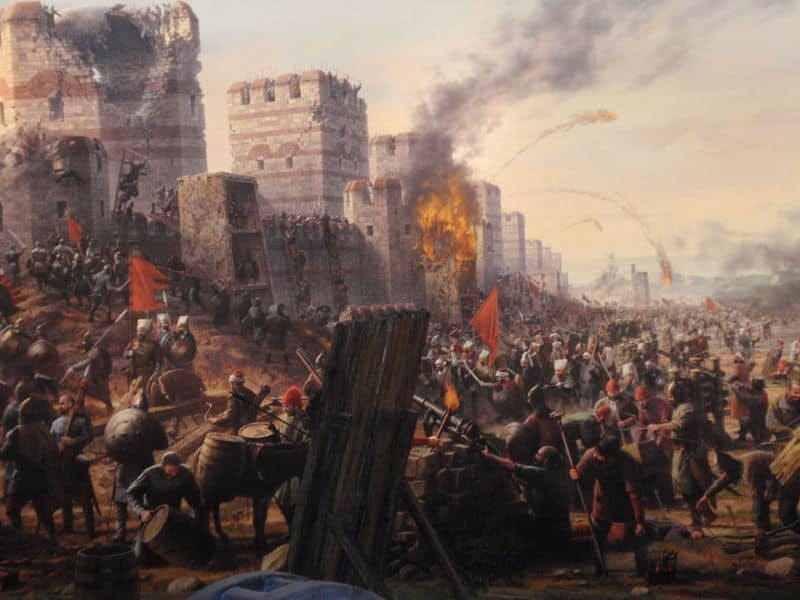
10. The Muslim conquest of "the city of the world's desire," Constantinople (now Istanbul), the seat of the Patriarch (rough equivalent of the Pope for the Eastern church; and thus the city's fall was roughly the same as if an American army were to conquer and then forcibly convert Mecca), barely a generation before Columbus
11. The Muslim conquest of all of the Christian Balkans, literally to the gates of Vienna as late as September 11, 1683, just 100 years before American independence and half a millennium after the Crusades.
12. The Muslim conquest and forced conversion of all of Zoroastrian Persia
13. The Muslim conquest and forced conversion of all of what we now call Central Asia
14. The Muslim conquest of and genocide in Hindu India, which took place after Columbus and at a time when that area had three times the population of all of Western Europe.
Sadly, I'm not even addressing the Muslim conquests and forced conversions of large parts of the rest of Africa or Southeast Asia. And you may draw whatever conclusions you will (if any) about the nature of Islam.
My point is simply that in even so much as mentioning the Crusades, you might as well say that Hitler was right when he blamed Poland for World War II. The concept is utterly ignorant of history at best, pure propaganda at worst. Indeed, you might as well blame a massacre on the publication of a cartoon.
Here are some great books on the Crusades for the Rod Martin Report:
* God's Battalions: The Case for the Crusades by Rodney Stark
* Defenders of the West: The Christian Heroes Who Stood Against Islam by Raymond Ibrahim
* The New Concise History of the Crusades by Thomas F. Madden
* The Crusades Controversy: Setting the Record Straight by Thomas F. Madden
* The First Crusade and the Idea of Crusading by Jonathan Riley-Smith
* Sword and Scimitar: Fourteen Centuries of War Between Islam and the West by Raymond Ibrahim
* The Crusades: The Authoritative History of the War for the Holy Land by Thomas Asbridge
* God's War: A New History of the Crusader States by Christopher Tyerman
The Crusades weren’t this evil thing that everyone makes them out to be. They were a noble war by the Christian knights of England, France and Germany to rescue their brothers in Christ in the East and liberate the holy city of Jerusalem from Muslim control. Islam had been a thorn in Christendom’s side for 400 years at the time of the First Crusade. They had invaded and conquered or at least tried to conquer, France, Italy, Spain, Portugal, Armenia, Egypt, Syria, Jordan, Iraq, Iran, Lebanon, Yemen, Libya, Algeria, Morocco, and Tunisia. On top of that, the Barbary Pirates operating out of North Africa had made the Mediterranean an unsafe h***hole for commerce. The Islamic Golden Age from the 8th century to the 13th century came at the expense of Christian Europe. Returning to the Barbary Pirates took 1.25 million white Europeans as slaves between the 16th and 19th centuries. The Muslim states then start threatening the Byzantine Empire also known as the Eastern Roman Empire and were persecuting Christian pilgrims in the holy land. Christendom after four centuries, had had enough. It was time to push back! In 1095, Byzantine Emperor Alexios I Komnenos sent ambassadors to the Council of Piacenza with an urgent request for military support in the empire’s conflict with the Seljuk-led Turks. This was followed later that year by the Council of Clermont, where Pope Urban II gave a speech calling for Catholics to rise up and take up arms in defense of their brothers in the East and to recapture the holy city of Jerusalem.
The Catholic and Orthodox Churches didn’t like or trust one another, but they put those differences aside to fight their common enemy. Christians from all across Europe came together in a way never seen before or since. The First Crusade would last from 1096 to 1099 and was a roaring success for the Christian armies. The Muslim states were defeated in almost every battle. Jerusalem was retaken for Christendom. The western flank of Christendom was stabilized. the Eastern flank of Christendom was bought another 300 years. Crusader states would be established in the holy land that would last for nearly 200 years. This is not to say The Crusades didn’t have flaws. Some knights fought for thrills or treasure rather than God. There were pogroms against Jews and massacres of civilians by members of the Crusader Army. Not all the Crusades were successful. Nonetheless, they are an inspiring story about how a group of pious men liberated Jerusalem and saved their brothers to the East. We need to stop viewing it as something shameful. It was a purely defensive conflict. Let’s debunk some myths about the Crusades shall we?
Historian and Medievalist Thomas Madden is a fountain of knowledge on this topic and all this information I will provide comes from Professor Madden. Myth #1: The Crusades were an unproved war of aggression against peaceful Muslims. As I touched on above, this is absolute nonsense! I quote Professor Madden, “From the time of Mohammed, Muslims had sought to conquer the Christian world. After a few centuries of steady conquests, Muslim armies had taken all of North Africa, the Middle East, Asia Minor and most of Spain.” He continues, “By the end of the 11th century the forces of Islam had captured two-thirds of the Christian world. Palestine, the home of Jesus Christ; Egypt, the birthplace of Christian monasticism; Asia Minor, where St Paul planted the seeds of the first Christian communities — these were not the periphery of Christianity but its very core.” Professor Madden concludes by pointing out “The Muslims continued to press westward toward Constantinople, ultimately passing it and entering Europe itself… At some point what was left of the Christian world would have to defend itself or simply succumb to Islamic conquest.”
Myth #2: The Crusaders wore crosses and pretended to be pious, but they were only interested in capturing booty and land. Professor Madden explains “Crusading was an enormously expensive operation. Lords were forced to sell off or mortgage their lands to gather the necessary funds. Most were also not interested in an overseas kingdom. Much like a soldier today, the medieval Crusader was proud to do his duty but longed to return home. After the spectacular successes of the First Crusade, with Jerusalem and much of Palestine in Crusader hands, virtually all of the Crusaders went home. Only a handful remained behind to govern the newly won territories.” He continues, “Money and land were not the reasons [for men to join the] Crusade in the first place. They went to atone for their sins and to win salvation by doing good works in a faraway land. They were very mindful of Christ’s exhortation that he who will not take up his cross is not worthy of Christ. They also remembered that “Greater love hath no man than this, than to lay down his life for his friends.”
Myth #3: When the Crusaders captured Jerusalem in 1099 they massacred every man, woman and child in the city until the streets ran ankle deep with the blood. Madden explains “It is certainly true that many people in Jerusalem were killed after the Crusaders captured the city. But this must be understood in historical context. The accepted moral standard in all pre-modern European and Asian civilizations was that a city that resisted capture and was taken by force belonged to the victorious forces. That included not just the buildings and goods, but the people as well. That is why every city or fortress had to weigh carefully whether it could hold out against besiegers. If not, it was wise to negotiate terms of surrender.” He continues “In the case of Jerusalem, the defenders had resisted right up to the end. They calculated that the formidable walls of the city would keep the Crusaders at bay until a relief force from Egypt could arrive. They were wrong. When the city fell, therefore, it was put to the sack. Many were killed, yet many others were ransomed or allowed to go free. It is worth noting that in those Muslim cities that surrendered to the Crusaders the people were left unmolested, retained their property, and were allowed to worship freely.”
Myth #4: The Crusades were just medieval colonialism dressed up in religious fiery. Madden quickly makes mincemeat of this allegation, “Catholic presence in the Crusader states was always tiny, easily less than 10% of the population. These were the rulers and magistrates, as well as Italian merchants and members of the military orders. The overwhelming majority of the population in the Crusader states was Muslim. They were not colonies, therefore, …they were outposts. The ultimate purpose of the Crusader states was to defend the holy places in Palestine, especially Jerusalem, and to provide a safe environment for Christian pilgrims to visit those places.” Myth #5: The Crusades were also waged against the Jews. Professor Madden debunks this narrative, “No pope ever called a Crusade against Jews. During the First Crusade a large band of riffraff, not associated with the main army, descended on the towns of the Rhineland and decided to rob and kill the Jews they found there. In part this was pure greed. In part it also stemmed from the incorrect belief that the Jews, as the crucifiers of Christ, were legitimate targets of the war. Pope Urban II and subsequent popes strongly condemned these attacks on Jews.”