

by John Haughey
May 7, 2026
The “storage clock” is ticking as tankers that exported 3.2 million barrels per day (bpd) of crude oil remain bottled up in Iranian ports by the U.S. Navy.
The blockade in the Gulf of Oman is a pressure-point tactic, part of a global strategy to deny Tehran $13 billion in monthly revenues and paralyze Iran’s petroleum industry by forcing it to shut down when it runs out of space to store what it can’t ship.
Since President Trump imposed the blockade on April 13, at least 1.5 million barrels of Iranian oil have been stored every day because there’s no place to move it.
Those barrels are starting to pile up. According to consensus industry estimates, including by UK-based Energy Aspects, up to 68 million barrels of Iran’s 122-million-barrel maximum storage was full in late April, and there was space for 20 million to 30 million barrels more.

The squeeze is rattling Islamic Republic leaders, Trump said.
“Iran has just informed us that they are in a ‘State of Collapse,’“ the president wrote. ”They want us to ‘Open the Hormuz Strait,’ as soon as possible, as they try to figure out their leadership situation.”
The president has expressed confidence that Iran will soon meet his demands to terminate nuclear weapons development, end support for terrorist groups, and withdraw its territorial claim — and effort to control — of the strait.
To calculate when these “state of collapse” concessions will manifest, time and space become coefficients in an equation. The answer is a so-called storage clock. It has one fulcrum constant: More time equals less space.

Kpler and JP Morgan analysts were among those in late April doing storage clock math, projecting that Iran would run out of time and space within 15 to 22 days—mid- to late May — if it can’t ship oil.
“Iran is being pushed into a storage-driven shut-in cycle,” analyst Homayoun Falakshahi wrote in a separate April 29 Kpler analysis. “Iran faces imminent forced shut-ins, with storage saturation likely within [about] 20–24 days, triggering rapid production cuts.”
Energy Aspects projected in late April that it could take up to seven weeks, or until mid-June, for the blockade to force shut-ins and shutdowns. Analyses by Wood Mackenzie, the Atlantic Council, the Center for Strategic International Studies, and the Center on Global Energy Policy at Columbia University, among many others, offer timelines that fall between.
Some maintain that Iran’s storage clock has already expired. The Institute for the Study of War and The Critical Threats Project at the American Enterprise Institute said Iran’s storage was depleted as of April 29.
The Foundation for Defense of Democracies projected there would be a shutdown by April 25.
Foundation senior fellow Miad Maleki, a former U.S. Treasury executive, estimated in an X post that Iran had approximately 20 million barrels of storage left on April 12 and predicted that within 13 days of maxing out capacity, “Iran must shut-in wells.”
No Way Out
Iran has four oil- and gas-producing regions. The Khuzestan fields have been producing since the 1960s, generating about 2.2 million bpd. West Karoun on the Iraqi border produces 500,000 bpd. The provinces of Fars and Bushehr along the Persian Gulf mostly produce offshore natural gas, including from South Pars, the Iranian sector of Qatar’s North Field, the world’s largest gas field. The fourth region is Iran’s Persian Gulf fields, with about 65 percent originating from the Kharg district’s three fields.
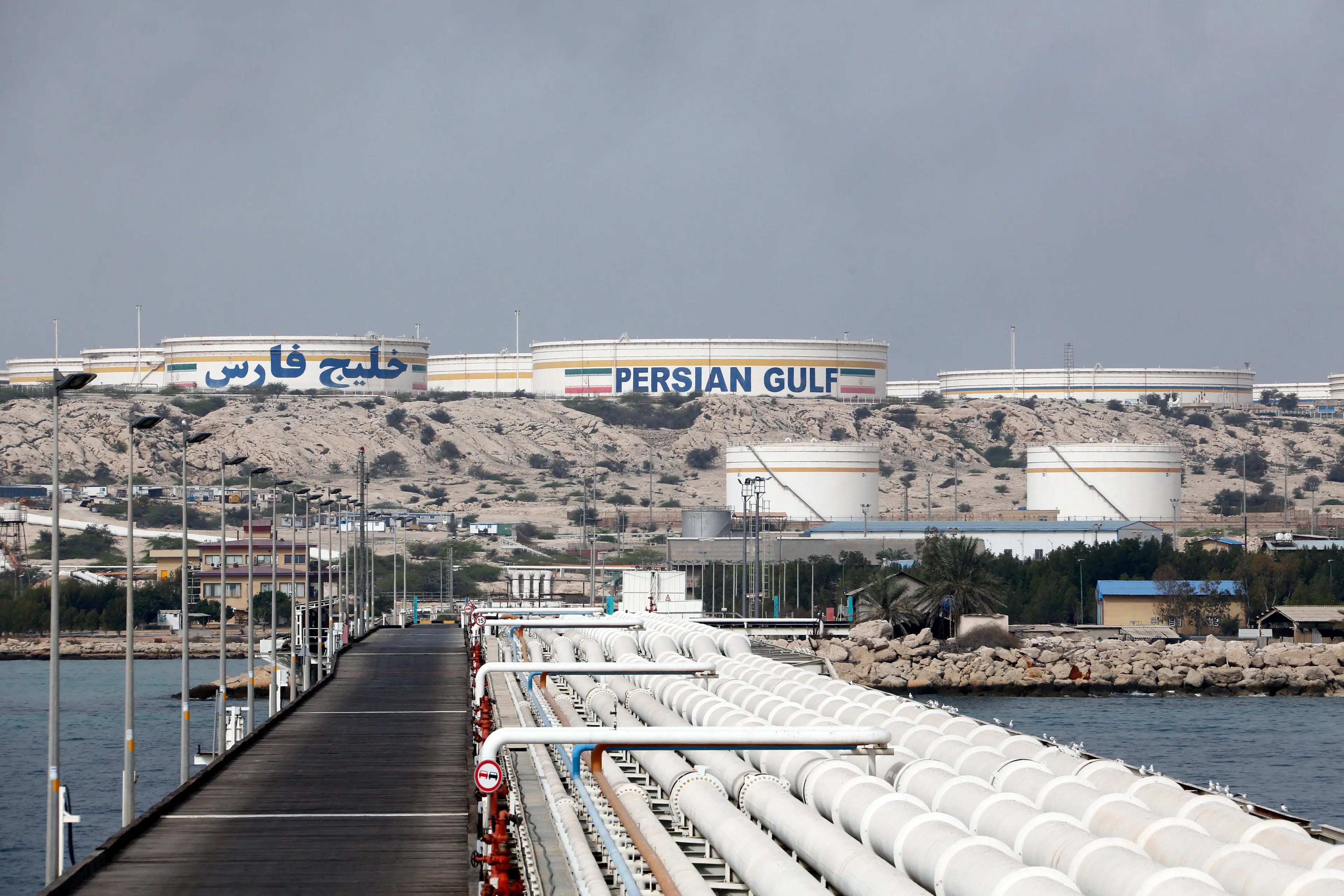
All roads, railways, and pipelines, and virtually all hydrocarbons extracted from Iran’s oil and gas fields, lead to Kharg Island, an eight-square-mile coral outcrop 300 miles north of the Strait of Hormuz that houses more than 25 percent of Iran’s storage capacity. Ninety percent of Tehran’s oil exports are pumped from terminals at Kharg into supertankers, up to 10 at a time.
By April 20, one week after the United States implemented the blockade, stored oil at Kharg Island was at 74 percent capacity, Center on Global Energy Policy fellow Antoine Halff wrote in an April 28 analysis.
U.S. Treasury Secretary Scott Bessent wrote on X on April 21 that storage on the island would be full “in a matter of days“ and that ”the fragile Iranian oil wells” would be shut in.
Four of Iran’s five other export-capable ports — Sirri and Lavan islands, Saroosh, and Assaluyeh near Bushehr — are inside the Persian Gulf. Only Jask is south of the strait, although no ships are using its newly built terminal on the Gulf of Oman with the U.S. Navy lurking nearby.
Although Iran has a robust domestic pipeline network, it only receives crude via cross-border pipelines for refining from Kazakhstan and Turkmenistan, and it only exports natural gas in pipelines to Turkey, Iraq, and Armenia.
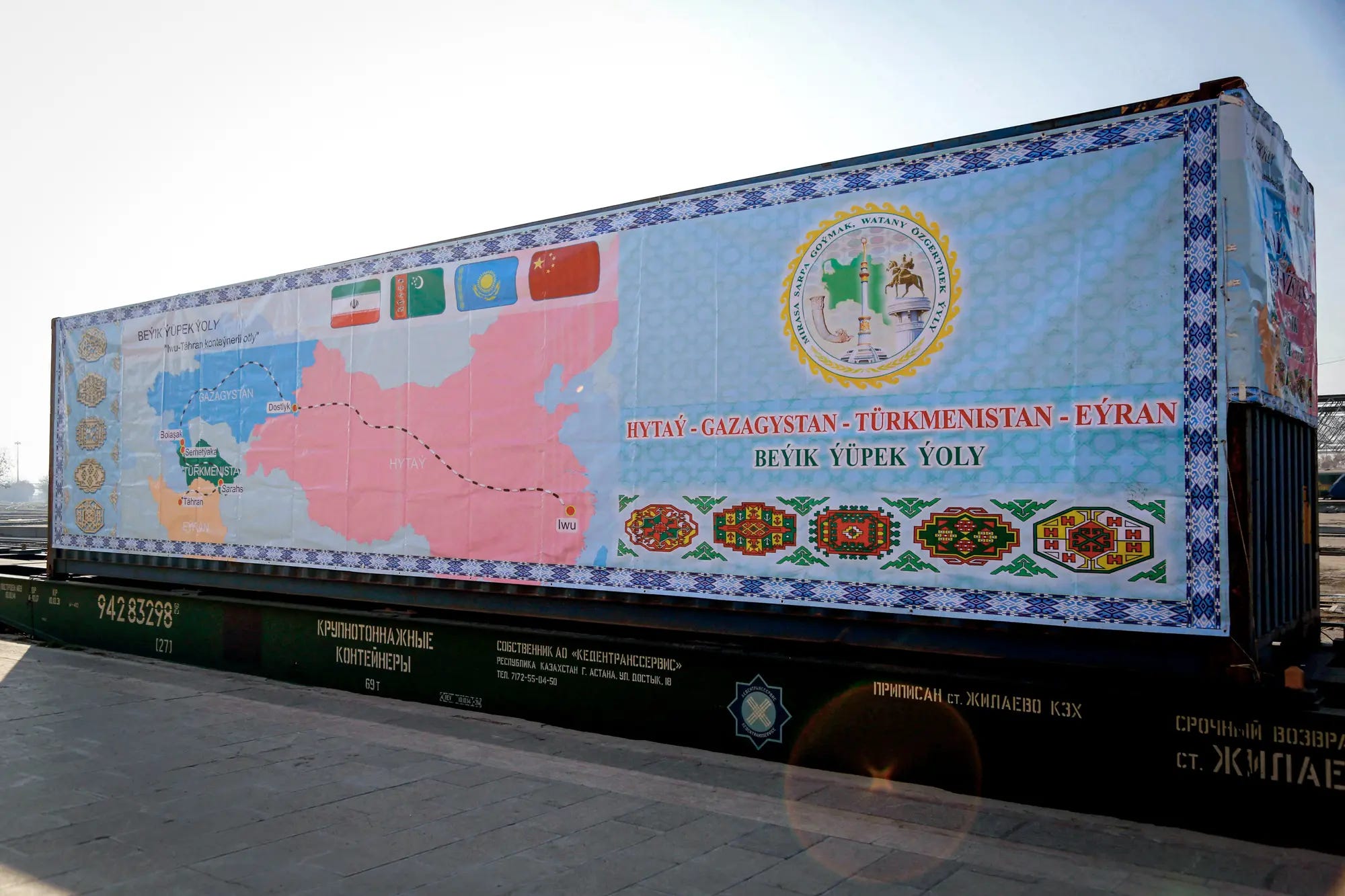
Tehran has limited capacity to expand exports by rail, although Iran Oil Exporters Union spokesman Hamid Hosseini said in widely reported comments that the regime is considering shipping oil by train on a newly built rail corridor from Iran to Yiwu and Xi’an in China.
But that capacity is highly limited. At most, Iran could ship no more than roughly 6 percent of its exports by this means. That does not solve its problem.
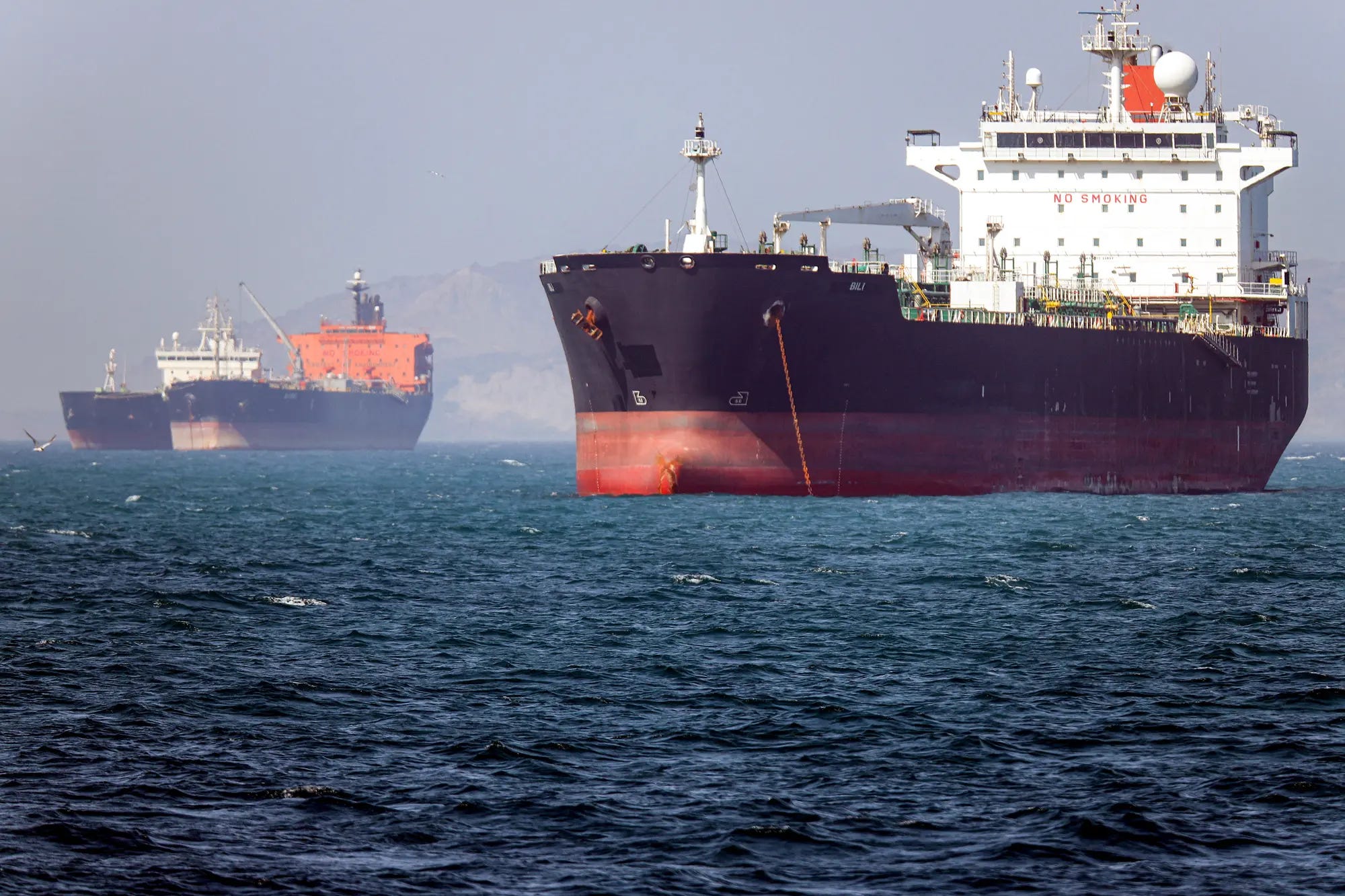
Unless the U.S. Navy lifts its blockade, Iran cannot move oil and gas out of the country, putting the same squeeze on Tehran that it has imposed on its Gulf State neighbors since early March — menacing the Strait of Hormuz, bringing Gulf trade to a standstill, damaging ports and infrastructure in drone and missile strikes, and marooning an estimated 20,000 sailors on ships anchored in limbo on “the Arab side” of the Gulf.
“When Iran first disrupted tanker traffic in the Strait of Hormuz, those Arab producers with the least available storage capacity and no export alternative were quick to ramp down production,” Halff said. “With the United States now restricting marine traffic to and from Iranian ports, Tehran faces the same conundrum.”
But unlike the Gulf Arab states, Iran has no good options. And time is running out: cashflow considerations aside, the damage to Iran’s oil wells could be extreme.
Here’s what comes next.
