


by Stuart J. Cvrk
August 5, 2026
The Democratic Socialists of America have achieved some shocking successes in primaries in the U.S. this year, especially in New York and now Denver where a youthful far left radical defeated a 15-term incumbent and member of the Congressional Progressive Caucus.
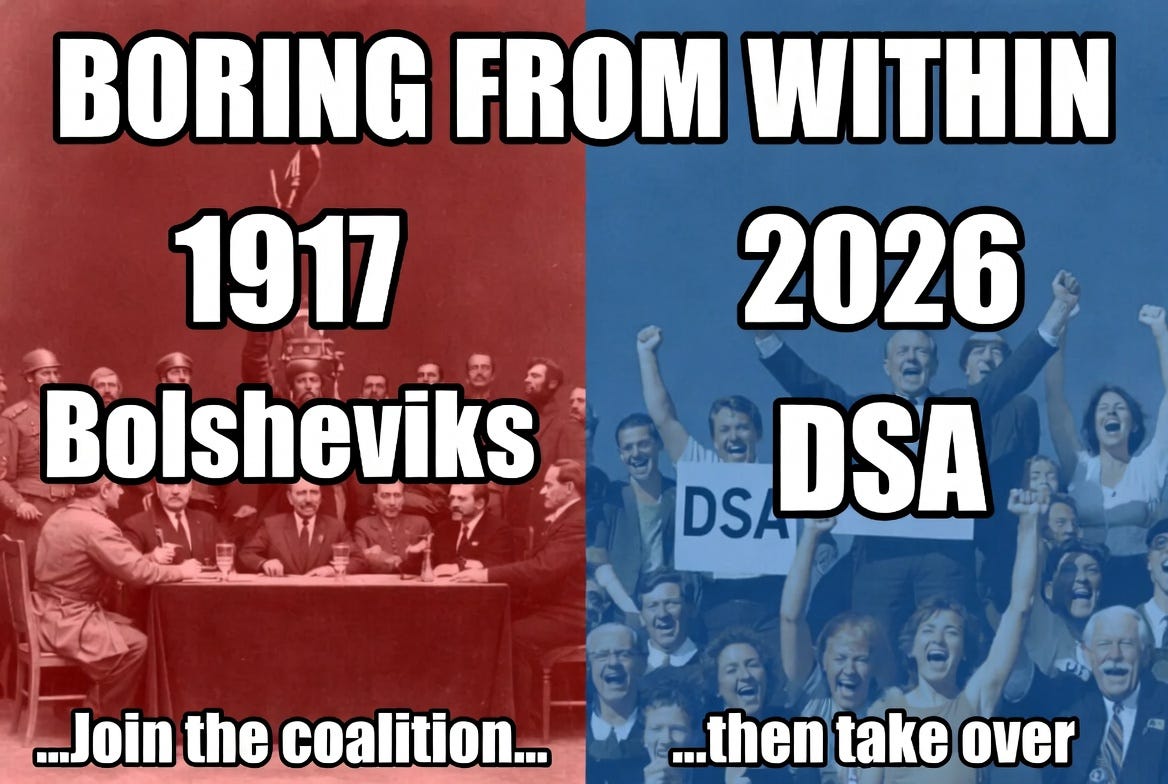
The past is prologue and frequently a window into the future. The analysis provided here examines a specific historical claim: that the DSA’s decades-long push inside the Democrat Party follows the same “boring from within” logic the Bolsheviks used against the Socialist Revolutionaries and Mensheviks in 1917 — a small, disciplined vanguard using a broader coalition’s legitimacy and infrastructure to gain position, growing more candid about maximalist goals as it consolidates power, with no intention of remaining merely one faction among many.
Drawing on current reporting on DSA’s 2026 platform, primary results, and funding ecosystem alongside the historical record of the Russian Revolution, this analysis works through where that parallel holds structurally, where it breaks down (method, institutional context, and end-state most notably), and what the primary-and-midterm evidence to date suggests about DSA’s odds of consolidating versus stalling out.
Let’s get cracking!
The Bolshevik Precedent — Mechanics, Not Metaphor
The term “boring from within” (an actual phrase used by Leon Trotsky and later by American Communist Party theorists like William Z. Foster) describes a specific tactic: a small, disciplined, ideologically rigid vanguard does not build its own mass party from scratch. It penetrates existing left-of-center organizations — trade unions, socialist parties, soviets — outworks and outorganizes the incumbent leadership, and eventually either converts or discards the host organization once it has served its purpose.
In 1917 specifically:
The Bolsheviks were a minority faction within Russian Marxism, split from the Mensheviks since 1903 over organizational discipline (a small vanguard party of professional revolutionaries vs. a broad mass workers’ party).
Through 1917 they did not initially control the soviets (workers’/soldiers’ councils) — the Mensheviks and Socialist Revolutionaries (SRs) held the majorities in the Petrograd and other soviets through much of the year.
Lenin’s strategy was to radicalize soviet rank-and-file through agitation (”All Power to the Soviets,” “Peace, Land, Bread”), outflank the SR/Menshevik leadership who were cooperating with the Provisional Government, and win soviet majorities district by district and city by city — Petrograd and Moscow flipped to Bolshevik majorities by September–October 1917.
Once positioned, the Bolsheviks executed the October coup in the name of “the soviets,” then systematically eliminated the coalition partners who had enabled their rise: the Left SRs (briefly allied in the first Bolshevik government) were purged after the 1918 Left SR uprising; the Constituent Assembly, where the SRs held the actual electoral majority, was forcibly dissolved after one day in January 1918; Menshevik and SR party structures were banned outright by 1921–22.
The declared and executed intent was never power-sharing — it was total, permanent seizure, codified in one-party rule and the elimination of rival socialist competition, not just rival capitalist parties.
That last point is the crux of the historical analogy people reach for: the Bolsheviks used their coalition partners as a ladder, then kicked the ladder away. And those actions include suppressing all dissent. It’s a model they’ve followed in nearly every nation that has fallen to communism.
Does it seem a bit familiar?
The DSA Parallel, Structurally
Applying the same lens to the current DSA project inside the Democrat Party, here are the structural moves that conform to the historical claim made above:
