
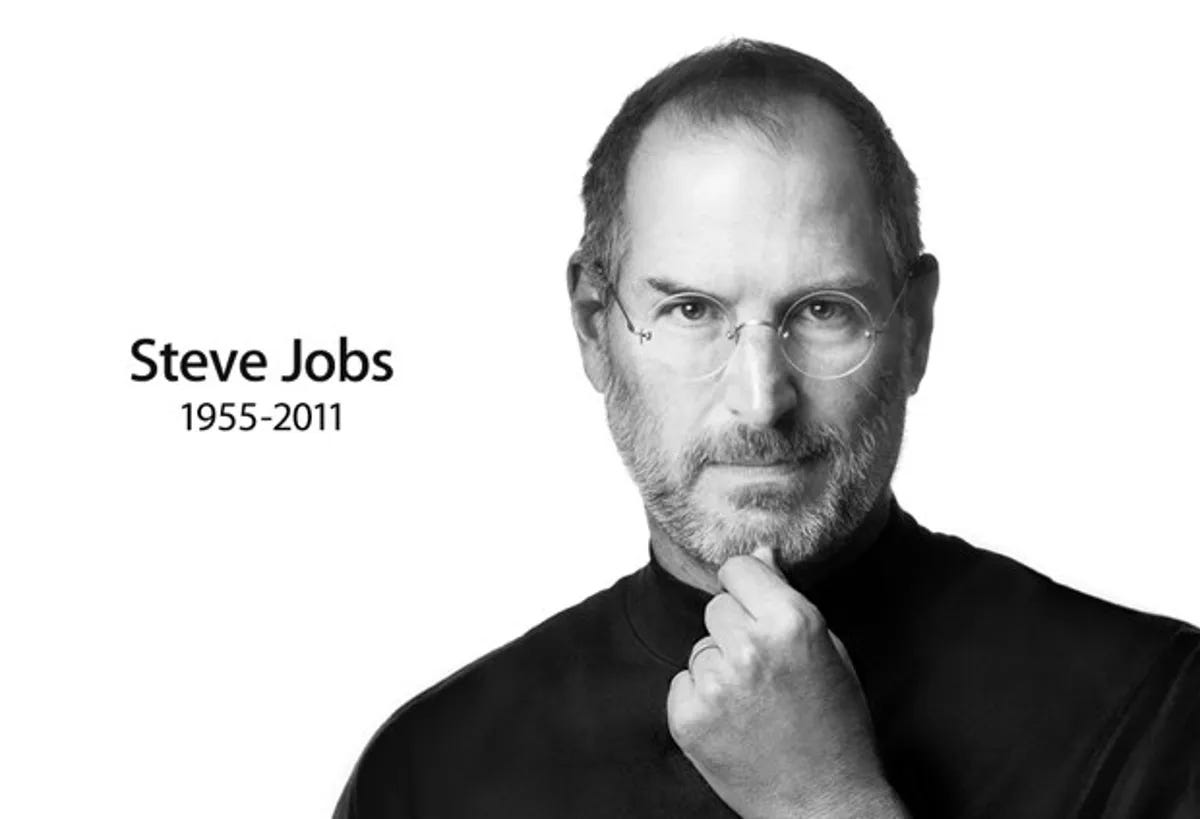
The world has been changed many times over by the brilliance of Steve Jobs. I could not begin in these short moments after his death to estimate his impact on me and mine. But a few thoughts deserve jotting down.
I first encountered Jobs in the pages of Fortune magazine, in 1982, wherein I first saw the Apple Lisa. I fell in love. Truly. It didn’t hurt that the girl I was utterly infatuated with (I was 12 at the time) shared its name. But that was a minor point, even then.
The Lisa was a vision, both in and of itself — she was beautiful — and of a world that was about to be. Her lines were elegant, flawless. In an age of black screens and DOS prompts, she seduced with the first commercially-available (for a mere $10,000) graphical user interface. She sported protected memory, cooperative multitasking, 2 megabytes of RAM (almost 10 years later the average PC would still have just 64K), and this amazing new thing called a mouse.
But the details were nothing. It was what the Lisa represented that mattered then, and now. The Lisa at least seemed to surpass anything in Star Trek, or the other science fiction of the time. To the degree it didn’t, it showed clearly that the future was happening, now, in our generation. Steve Jobs was barely older than we were — and in those days he looked almost our age — and it was perfectly clear: the future was here, and we were going to make it.
If there were any 12 year olds who could afford a Lisa, I certainly wasn’t one of them; so I dreamed of it and imagined truly extraordinary uses for it…and watched as it died and the Macintosh replaced it. Not too long thereafter I had fellowship money to buy my own Macintosh, a Macintosh SE with dual 3.5 inch floppy drives, 1MB of RAM, and a then-shocking 30MB hard drive. I still have and use files I created on that machine (in fact, I still have that machine).
What I also watched was Microsoft completely rip off the MacOS (not yet called that), and get away with it, purely because intellectual property law hadn’t caught up with the realities in the field. I watched Jobs get kicked out of his own company, go on to found two other companies, and simply never say die. I saw Apple launch the amazing System 7 and the prescient but not-yet-ready Newton (a brilliant attempt at a tricorder which probably would have captured the market later defined by Palm had Jobs then been running Apple), only to stumble into decay and decline. Gil Amelio made the hard decisions required to save the company, only to be repaid by being booted out for the return of…Steve Jobs. Rarely mentioned was Jobs’ careful following of the long-term plan Amelio had crafted; but his charisma unquestionably breathed as much new life into Apple as NextStep/OS X, the iMac and the iPod.
I was finishing law school when Jobs came back. I was on my third Mac by then, about six Macs, two iPods, four iPhones and an iPad ago, not counting family and staff. No one believed in Apple. There was still talk of the “famous Steve Jobs reality distortion field”. I knew better. I was right.
What was I right about? Or more to the point, what was Steve right about?
That product design should be relentlessly elegant, beautiful and flawless. That it really is better not to release a product at all than to release a crappy product. That things should “just work”.
That technology should not be about incremental change: if it isn’t an order of magnitude better, what’s the point?
That technology, no matter how gee-whiz the form it takes, is about solving real problems real people already have. The Mac was “the computer for the rest of us”. It wasn’t created to “get you to do new stuff”. Like the Model T, it was invented to do something you already needed to do, way way better.
That the role of the visionary, whether or not a technologist, is to see problems people don’t know they have and solve them. That the classical economists like Adam Smith were right (and the leftist economists like Keynes and Marx were wrong) when they asserted that supply creates demand, and not the other way around. That the profit generated by all of this makes possible a radically better world.
That to create great products and great technology reduces the world’s poverty, levels the world’s playing field, and more than most things one can do, likens us unto the Creator, Who made us in His Creative Image.
Steve Jobs didn’t understand that last bit. But he modeled it, and he intuitively understood and relentlessly demonstrated the truth in the rest. We are all richer because of him, not just in the hours of needless work saved, the millions of businesses (and jobs) created, and the immeasurable human creativity unleashed because of his work; but also by the wisdom he gave us on the cusp of this new age. He is truly one of the greats, a Leonardo, a Rockefeller, a Stanford, an Edison, a Ford, a Curtis, a Hughes.
In short, he was one of those extraordinary few who truly “thought different”.
About Rod D. Martin
Rod D. Martin, founder and CEO of The Martin Organization, is a technology entrepreneur, futurist, hedge fund manager, author and conservative activist from Destin, Florida. Fox Business News calls him a “tech guru”, Britain’s Guardian labeled him a “philosopher-capitalist”, Gawker called him “another of Peter Thiel’s brilliant nonconformists,” and George Washington University’s Graduate School of Political Management introduced him as “America’s foremost [conservative] expert on online politics.” He was a senior member of PayPal's pre-IPO startup team, served as Mike Huckabee's policy director, and is President of the National Federation of Republican Assemblies (NFRA).


Rod Martin is a mentor, a wise counselor, a brilliant strategist, a visionary, and a builder. He is one of a precious few souls the world could use far more of.
Rod Martin is one of America’s finest young minds.
If Rod Martin represents the next generation of leaders, America has nothing to worry about.
Rod Martin has been a consistent advocate and a real conservative mover and shaker. He’s not new to this business. He’s got a great history and a great future.
Rod Martin is a Reaganite-Thatcherite conservative…[and] a man who has spent much of his life ministering to and working for the benefit of others. I know Rod as an advocate for freedom, a leader who understands the real changes we need in Washington, and who has the drive and ability to make those changes happen.
I am proud to have been Rod Martin’s friend for a quarter century, and I can tell you that he is one of the finest men and most outstanding leaders in our church and in our country today. He has a knack for turning everything he touches to success.
Rod Martin has a unique combination of personal integrity, economic acumen and entrepreneurship. He is a man to be trusted and his business foresight is a matter of public record.
Rod Martin is one of those impressive Renaissance types whose genius spans politics, economics, philosophy, technology and history. These are the qualities of a truly visionary entrepreneur. Rod has them in spades.
America badly needs more leaders who really get the future. We need more Rod Martins.
Rod Martin wears with uncommon grace an uncanny ability to link his vigorous faith to the practical challenges of both the business world and the political arena. Yet the respect he shows for others carries a warmth and modesty that are both too rare among those who are strong advocates of feisty positions.
Rod Martin is a cornucopian entrepreneur and eutropic thinker whose influence radiates through an array of companies, institutions, movements and churches. A renaissance American, he is also a prolific friend of freedom and faith around the globe.
Rod Martin is the kind of dynamic leader who has the knowledge, ability and experience to lead us successfully into the 21st Century. His vision for America is compelling.
One of America’s most brilliant, creative individuals, my friend Rod Martin exhibits the finest traits of the global entrepreneur.
The future of technology is the future of America. Rod Martin sees that future clearly, and also sees how to shape it for the betterment of all. He is firmly rooted in the traditions of faith and patriotism that have made America great. That’s why he has made, and will make, so many outstanding contributions in so many areas.
Rod Martin is a man of uncommon vision and character. Ever since I first worked alongside Rod in the early days of PayPal, I’ve been struck by his powerful vision for the future. Rod understands the intersection of technology, politics and culture in a way that few others do.
A leader and a servant, in public life and in private, Rod Martin strides at the top of his profession, and has nowhere to go but up. He is in the truest sense of the word ‘outstanding’.
Rod Martin is undoubtedly one of the most accomplished thought leaders at the interface of technological innovation and entrepreneurship today. He is a wonderful mentor, a humble role model, and a deep inspiration for the next generation of scientific innovators and entrepreneurs.
Rod is humble yet brilliant, a conservative to his very core and a man of love and compassion. He is not easy to categorize; but with penetrating clarity, he illuminates the world around us, and we are both stirred and enlightened.
My friend Rod Martin brings to politics and government incredible experience and insight, including how to use very advanced technology to motivate huge groups of people on an everyday basis.
Rod is one of the sharpest, most gracious men I know, and one of the most gifted political thinkers today. His ability to analyze issues and communicate thoughtful insights on them have earned him the respect of people across the political spectrum.
Rod Martin is a modern day philosopher-statesman. He is a capitalist intellectual, a conservative iconoclast, a gentle adversary and a kind prophet. He inspires us towards a fresh national vision built upon the original founding principles.
Rod Martin is a born leader and an outstanding political mind. Anyone who takes him on is going to have a serious fight on their hands.
Rod Martin is not only effective and efficient, but he is also perceptive, wise and gracious. He gets things done. He is a great friend and a great ally.