


by Rod D. Martin
October 31, 2015
Democrats who pretend their party never fought a Civil War to defend slavery or established an Apartheid regime in America for most of a century after that nevertheless love to claim that the Republican Party is made up entirely of their racist cast-offs. They usually attribute this to Richard Nixon's "Southern Strategy" in the 1968 campaign, ignoring that (a) in the years in question, no Republican presidential candidate failed to support civil rights legislation, (b) Nixon himself deliberately expanded it, and (c) the Democrats (in many cases "reformed" Segregationists) continued to hold virtually all offices in the South for 20-30 more years.
No, Kevin Phillips may think that the Southern Strategy was about race, but it was mostly about the Great Society, the hippie insanity of the late Sixties, and afterward the hippie takeover of the national Democratic Party embodied in George McGovern. Jimmy Carter drove the final nail in the coffin, not by being racist, but by being...awful.
Nevertheless, I get comments and letters, like this one from Facebook today:
When Nixon adopted the Southern strategy, he made an appeal to the racist Dixiecrats who left the Democratic Party after Johnson signed the Civil Rights Act. If the GOP should return to its roots, that would be a good thing.
While I certainly agree that Republicans should work harder at reaching out to people of all backgrounds, this is just nonsense. Here's my response:
=======
Richard Nixon? Seriously? Do you realize that 53.6% of all eligible voters -- including a good percentage of the Republican Presidential field and the sitting President of the United States -- aren't old enough to have a meaningful political memory of Richard Nixon?
Or let's put that another way: the youngest politically active Segregationists in 1969 are now about to turn 70, and virtually everyone of that age group AND the one above it repudiated the politics of their elders, which is how you got Democrat governors like Dale Bumpers (who was actually 45 in 1970 when wiped Orval Faubus off the map in the Democratic primary). The Segregationist leaders are mostly all dead, but if they were alive today, lets look at their ages:
George Wallace - 96 (dead)
Bull Connor - 118 (dead since 1973!)
Orval Faubus - 105 (dead)
Justice Jim Johnson - 91 (dead)
Richard Russell - 118 (dead)
Al Gore, Sr. - 108 (dead)
J. William Fulbright - 110 (dead)
Olin Johnston - 119 (dead)
John Stennis - 114 (dead)
John L. McClellan - 119 (dead)
Strom Thurmond - 113 (dead)
Jesse Helms - 94 (dead)
Robert Byrd - 98 (dead)
Harry Byrd - 128 (dead)
Spessard Holland - 123 (dead)
George Smathers - 102 (dead)
Russell Long - 97 (dead)
James Eastland - 111 (dead)
Sam Ervin - 119 (dead)
Wilbur Mills - 113 (dead)
Bob Sikes - 109 (dead)
Carl Vinson - 132 (dead)
Of all these named -- and the umpteen others who signed the Southern Manifeso -- only two became Republicans. Again, they're both dead. More to the point, like several of the Democrats named above, they later repudiated their previous racism, which I think we'd all agree they couldn't and probably wouldn't have done if their constituencies hadn't dropped those views before they did. And for that matter, while it's easy to pretend the Southern Strategy was all about race, you deliberately ignore that Nixon -- never a racist -- was capitalizing far more on Hubert Humphrey's advocacy of a massive expansion of the federal government, and on George McGovern's crazy hippie flower child campaign. If you think opposition to that turned on racism, then I guess Lenin's opponents in Russia were driven by Klan loyalties too.
In any case, 53.6% of American voters -- including Barack Obama, Ted Cruz, Marco Rubio, Rand Paul, et al. -- probably couldn't tell you who half these people were, have no memory of most of them, and think of segregation like they think of the Missouri Compromise or the Roundheads. I don't know how old you are, sir, but pretending that these ancient battles have any relevance to a Republican primary voter today is self-delusion, if not propaganda. You might enjoy the moral superiority you think it gives you, and you might even score a few cheap propaganda points (themselves ignoring that the Klan was always an organ of the Democratic Party, and 100% of Jim Crow legislation came from and was defended by Democrats). But you're living in a fantasy world. Richard Nixon has as much relevance to this election as Benjamin Harrison.


An excellent old piece that is still relevant as ever in the Trump era! There was no “Southern Strategy” on the part of Republicans anyway, that is a myth. The South became Republican for a variety of reasons none of which have to do with anti-black racism. The South turned red because 1) The South is the most conservative part of the United States and it was around this time we’re talking about that the conservative faction of the GOP became predominant. 2) Demographic change 3) Businesses started moving down South 4) The introduction of air conditioning in South. 5) The end of racial segregation. Also, by the time of the 1968 Presidential Election race was no longer a big issue for white Southerners anymore.
They were more concerned with things like the size of government, welfare and busing. This is why Nixon’s campaign against Hubert Humphrey wanting to massively expand the government and George McGovern’s flower power campaign played so well in parts of the South. But it took awhile for the Republicans to really establish themselves firmly in the South. It wasn’t really until the 1990s that that GOP finally locked the South down. Furthermore, it wasn’t until the 2010s that the GOP had control of all the Southern state legislatures. Of all the hardcore segregationists who signed the Southern Manifesto, only two became Republicans. Many including the two Republicans, would later repudiate racism.
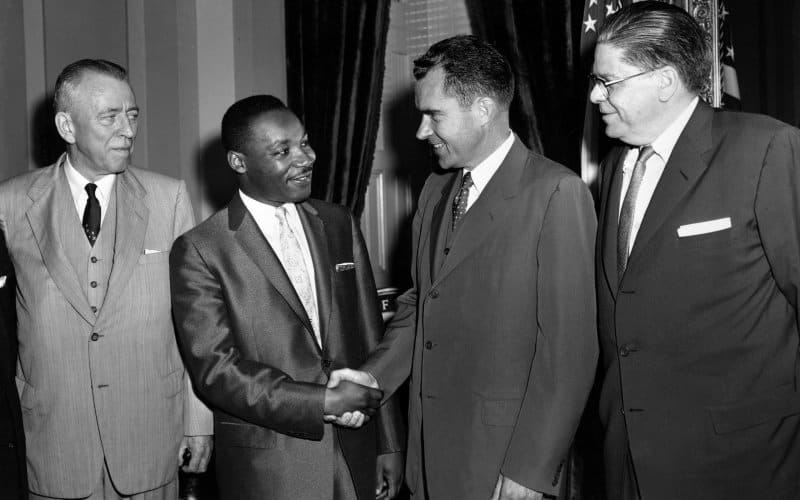
As to Richard Nixon, Nixon was neither a racist or ran on racism. Nixon was a champion of civil rights throughout his political career. Nixon for a time, was friends with Martin Luther King, Jr. and remained lifelong friends with his father Martin Luther King, Sr. Nixon was endorsed by Jackie Robinson during his 1960 Presidential Campaign. NBA legend Wilt Chamberlain endorsed Nixon during his 1968 and 1972 Presidential Campaigns. As President, Nixon desegregated 80% of Southern schools, introduced the first affirmative action program the Philadelphia Plan, extended the Voting Rights Act, and gave aid to black businesses. Nixon also signed a slew of legislation to assist the Native Americans. He invited Sammy Davis Jr. to the White House and put him up in the Lincoln Bedroom. He invited the great black Jazz artist Duke Ellington to the White House on his 70th birthday and presented him with the Presidential Medal of Freedom.
Nixon marched in MLK’s funeral procession and after the funeral visited Martin Luther King Sr. and the two shared a warm hug with one another. He then visited Coretta Scott King and MLK’s children and left Mrs. King a check for the children’s education. He specifically mentioned blacks and Mexicans as being part of the great silent majority at the 1968 RNC in Miami. Now to address the statements Nixon was caught making on his White House tapes about blacks, Jews, Mexicans, Italians, and the Irish, these statements were offensive and unacceptable. But they do not reflect who he was or how he treated others. They more so reflect the fact that Nixon didn’t have a filter rather then him actually being prejudiced or bigoted.
It was in fact, the Democrats who had a real Southern Strategy. Democrats in the South ran on anti-black racism to get votes for a century. Even the man who signed all the major civil rights legislation, Lyndon B. Johnson ran against civil rights during this political career in Texas. The Democratic Party historically, was the party of slavery, Jim Crow, lynching, poll taxes, literacy tests, and grandfather clauses. The Ku Klux Klan was the fighting arm of the Democratic Party. It was the Democrats who fought the hardest against civil rights legislation and passed the laws that created the Jim Crow system in the South. The Republicans historically were the party of Lincoln who stood against slavery and whom imperfectly but sincerely, stood up for civil rights.
Ulysses S. Grant, Rutherford B. Hayes, James Garfield, Chester Arthur, Benjamin Harrison, and William McKinley to one degree or another, were all civil rights champions. Theodore Roosevelt and William Howard Taft both held paternalistic racist views towards black people but nonetheless, they too both supported black advancement. Warren G. Harding, Calvin Coolidge and Herbert Hoover all stood up for civil rights to various degrees.
Dwight D. Eisenhower completed the desegregation of the military, desegregated Washington D.C., sent the 101st Airborne to protect the Little Rock Nine, appointed pro-civil rights justices to the Supreme Court, and backed the Brown v. Board of Education decision by the Supreme Court. Gerald Ford and his teammates when he played college football at Michigan, famously knocked a Georgia Tech player out of a game because he called their black teammate Willis Ward the n-word. Ronald Reagan had black friends growing up and loathed racial prejudice. George H.W. Bush voted for the 1968 Fair Housing Bill as a congressman and as President signed the Civil Rights Act of 1991 and appointed Clarence Thomas to the Supreme Court. George W. Bush appointed more women and minorities to work in his administration than any previous President had and reauthorized the Voting Rights Act. Don’t even get me started on all the good Donald Trump has done for minorities! Meanwhile, Woodrow Wilson was a staunch champion of racial segregation, FDR and JFK dragged their feet on civil rights and Bill Clinton locked up more black people than anyone alive today. Joe Biden had some a…rather interesting things to say about race:
“Poor kids are just as bright and just as talented as white kids.”
“I don’t want my children living in a racial jungle.”
“There was some civility there, they called me sir not boy.”
“One day this black guy came to pick me up in a limo.”
“Come over here Barack!”-to a totally different black man in the audience.
“If you have a hard time choosing between me and Trump, you ain’t black.”
“They want to put ya’ll back in chains.”-to a black audience
“I took on this bad dude named Cornpop.”
I also thought this quote from an SNL skit by Woody Harrelson playing Biden was pretty accurate:
“Your sacred of me America. You’re afraid I’m gonna say something off color or even worse on color. I’m here to say, you should be sacred because I’m always one second away from calling Cory Booker Barack.”
Here are some volumes on Republican efforts to fight slavery and for civil rights:
• Lincoln's Emancipation Proclamation: The End of Slavery in America by Allen C. Guelzo
• The Black Man's President: Abraham Lincoln, African Americans, & the Pursuit of Racial Equality by Michael Burlingame
• The Unknown Architects of Civil Rights: Thaddeus Stevens, Ulysses S. Grant, and Charles Sumner by Barry M. Goldenberg
• Klan War: Ulysses S. Grant and the Battle to Save Reconstruction by Fergus M. Bordewich
• America's First Freedom Rider: Elizabeth Jennings, Chester A. Arthur, and the Early Fight for Civil Rights by Jerry Mikorenda
• Forgotten Legacy: William McKinley, George Henry White, and the Struggle for Black Equality by Benjamin R. Justesen
• Guest of Honor: Booker T. Washington, Theodore Roosevelt, and the White House Dinner That Shocked a Nation by Deborah Davis
• A Matter of Justice: Eisenhower and the Beginning of the Civil Rights Revolution by David A. Nichols
• Ike's Final Battle: The Road to Little Rock and the Challenge of Equality by Kasey S. Pipes
• Nixon’s Civil Rights: Politics, Principle, and Policy by Dean Kotlowski
• Free Soil, Free Labor, Free Men: The Ideology of the Republican Party before the Civil War by Eric Foner
• The Radical and the Republican: Frederick Douglass, Abraham Lincoln, and the Triumph of Antislavery Politics by James Oakes